
May 18, 2022
ClickUp Email vs. Missive
A detailed comparison of ClickUp Email vs. Missive—from inbox organization and templates to automation, multi-channel support, and pricing—so you can decide which tool fits your team.
Since the 90s, “business communication” and “email” have been nearly synonymous. Email is where communication happens, whether it’s emailing a client request, ticketing for IT support, or onboarding a new employee.
Yet, if we’re being honest, most of us still think our email inbox is where productivity goes to die. There has to be a better way, doesn’t there?
Enter: Missive and ClickUp’s Email ClickApp.
These platforms allow you to take your inbox from a “me” space to a “we” space. And, yes, both of these tools will allow you to explore their email features for the unbeatable price of free.
Yet, if we look under the surface and examine the features and missions of each of these companies, they couldn’t be more different. On the one hand, Missive is a full-featured email client with multi-channel integrations. On the other hand, ClickUp is a work management platform that can send and receive emails, sort of.
So, if we were to compare Missive vs. ClickUp Email, which is better?
As a ClickUp expert and a Missive power user, I want to take you through the day-to-day features that will matter most for your email productivity so you can decide for yourself.
Key Takeaways
- Core Focus: Missive is a dedicated collaborative email client; ClickUp is a project management platform with email features bolted on.
- Collaboration: Missive offers internal chat, collaborative drafting, and round-robin assignment directly within email threads.
- Task Management: ClickUp excels at complex project tracking, while Missive keeps tasks lightweight and conversation-based.
- Multi-Channel: Missive handles SMS, WhatsApp, Instagram, Facebook, and live chat alongside email. ClickUp is limited to email and internal comments.
- Best Together: You don’t have to choose—Missive integrates with ClickUp so you can use each tool for what it does best.
Missive vs. ClickUp Email at a Glance
FeatureMissiveClickUp EmailPrimary UseCollaborative Email & ChatProject & Task ManagementShared InboxNative, deep functionalityNo centralized inboxInternal ChatSide-by-side with emailsTask comments onlyCollaborative DraftingReal-time co-writingNot available for emailEmail Aliases (support@, hello@)Unlimited aliases includedNot supportedMulti-Channel (SMS, WhatsApp, Social)Full supportEmail onlyMobile EmailFull-featured appCannot send email from mobileEmail AnalyticsBuilt-in reportingNot availableAuto-Assignment (Round-Robin)YesNoDynamic Variables in TemplatesManual & automated emailsAutomated emails only
Email Organization & Delegation
Tasks vs. Conversations
It is essential to understand how differently emails are organized in ClickUp Email vs. Missive to start our journey.
Conversations are the core of Missive’s user interface. Scrolling along your left sidebar will feel instantly familiar for anyone who’s used Outlook or Gmail in the past, making the Missive learning curve effortless.

Of course, Missive has more superpowers than your average email client – but we’ll talk about that later.
Meanwhile, Tasks are at the center of ClickUp’s email feature. ClickUp users go directly inside a Task’s Activity panel to compose an email. If your email receives a reply, you’ll see it alongside other updates inside ClickUp Notifications.

However, if no one replies to your ClickUp email, you’ll have to search back through all your ClickUp Tasks to find the email you sent. (Speaking from experience here – it’s not a pleasant process.)
Oh! And just as a reminder before we dive deeper: We’re talking today about ClickUp’s email from ClickUp feature, also called the Email ClickApp, where you can send emails to and from ClickUp. This ClickApp is distinct from ClickUp’s one-way email to ClickUp feature, which only turns emails into one-off Tasks.

Creating Categories to Organize Emails
Have you ever been in your inbox and thought, “Oh! I’ve answered this type of request before, haven’t I?”...and then found yourself scrambling through your Sent emails to find that precious example you forgot to save? If so, you know precisely why inbox organization can make or break email productivity.
Missive helps you organize your inbox through Labels, Team Inboxes, and My Inbox.
- Labels are like tags you can apply to any conversation to file them away for safekeeping. For example, when the snazzy folks over at Missive invited me to write this post, I added the Label “Potential Sponsorship/Collab” to the email so we could easily find this conversation later!

- Team Inbox(es) sort all conversations into a virtual “pile” for relevant team members. For example, we have an inbox for Customer Experience (CX) where we’ll automatically put all of our customer requests.
- When an email is manually or automatically placed in this Inbox, the whole Customer Experience team can see the communication and get to work. Every department can see communication relevant to them without anyone forwarding emails back and forth!

- Finally, My Inbox allows you to manage all conversations that you personally need to take action on.

ClickUp’s email feature, in contrast, doesn’t have its own organizational structure. There is no centralized email inbox in ClickUp (although they’re considering it). The Task you send the email from is where your ClickUp-originated email will always live.

ClickUp’s task-based structure makes it impossible to see an overview of all emails.
Merging Emails & Conversations
Last month, we received an email from a client and that client’s assistant regarding the same request: updating a password. Two separate emails hit our inbox within an hour.
If we were emailing in ClickUp, we would have been stuck! In ClickUp, email conversations (and their replies) cannot be moved, merged, labeled, or reorganized. They’re stuck exactly where they were first sent (or received).

In Missive, we could easily select both emails and click “Merge Conversations.” Magically, the two emails became one Conversation that could be tackled by one Customer Support rep comprehensively.

If your inbox gets as messy as ours does, you’ll probably find the ability to Merge Conversations to be one point for Missive!
Separating Tasks from Emails
Emails often include a mix of information and Tasks. Productive teams know the value in breaking this information apart so no action item is forgotten.
In Missive, you can create a Task inside any Conversation (manually or automatically through a Rule) by selecting the Task icon when commenting. Tasks create little checkboxes inside a Conversation that you can easily assign to one or multiple people.

In ClickUp… well, Tasks are their specialty!
To create Tasks from emails in ClickUp, you’d select “Assign” on any message. This creates an Assigned Comment.

ClickUp Assigned Comments also include more formatting and a Remind Me feature. Because they’re integrated directly into your regular Task List, it’s a great way to ensure no Task is left behind!
Templating Your Emails
Creating Templates of Emails
Email templates are invaluable tools for inbox efficiency. Luckily, both ClickUp and Missive include email template features.
In ClickUp, Email Templates are housed within the “magic wand” icon inside any email composition area as long as you’re on ClickUp’s Business Plan or higher.

Once inside, ClickUp greets you with a robust lineup of formatting options including headers, banners, and embedded content.

In Missive, email templates are called Responses. (I suspect this, in part, is because Missive can handle far more than just emails – more on this later!) Managing Missive’s Responses happens inside the Settings menu.

Once open, you can create a new template as effortlessly as writing any standard email, including text formatting and adding images. The whole experience is slick and included on every Missive plan.

The only downside to both of these tools is that neither software allows you to create templated messages written in HTML (yet).
Add Dynamic Variables to Emails
No one likes templated emails that feel like templates. That’s where dynamic variables come in. Dynamic variables allow you to personalize parts of a message based on sender or recipient data.
For example, if we had a dynamic variable for “Recipient’s First Name,” instead of an email saying, “Hi [first name]!” it might say, “Hi Layla!”
If we didn’t know the recipient’s name, we might have a fallback value of “there” so, if we didn’t know a first name, we’d say “Hi there!” to cover all our bases.

In ClickUp, dynamic variables are only available for emails sent via a ClickUp Automation. (You cannot set any dynamic variables in standard ClickUp email templates.)
When triggered, ClickUp Automations will pull data from the Trigger Task and use that to send an email automatically.
To work, every Task sending emails must have data filled in through all relevant Custom Fields of a specific data type. Usually, this requires a lot of data entry, but it’s crucial.

ClickUp’s email variables do not allow for fallback variables, so if any Fields are blank when the automation is triggered…your email might look a little bizarre!

In the example screenshot above, we forgot to fill out the Due Date so our sentence reads “Please complete the example task by .” instead of “Please complete the example task by January 1, 2025.” Oops!
Missive takes a much more flexible approach to dynamic variables. Variables in Missive are available for both automated and manual emails.

When creating a new Custom Variable, creators can decide whether to populate this data automatically or manually. Even though Missive variables cannot yet be formatted (all Missive variables are currently strings), these options provide ample space to explain the meaning behind each variable.

Variables, in my opinion, are one of Missives most underrated features.
Editing & Updating Email Templates
Okay, so we’ve built some stellar email templates. How do we keep them all up-to-date? This is where a solid email template management center can make all the difference.
Editing Responses in Missive is straightforward. When you select Insert Response (or are just browsing Responses), locate the Response’s ellipses menu and select Edit. You can alter anything about the Response in seconds. Your edits are immediately saved, and your template just got that much better!

ClickUp’s email templates, as we’ve alluded to before, are a bit trickier to manage. Email templates are not part of ClickUp’s template center and, instead, can only be found by selecting the “magic wand” icon that appears near any email composition area.

Once inside this manager, you can select the pencil to edit any template. Just don’t forget to click Save!

Consistently Branding Email Signatures
First impressions matter, and that’s true for email, too. Both Missive and ClickUp’s Email ClickApp spoil us with the ability to create on-brand email signatures for all users by utilizing either text or HTML formatting.
In Missive, we can define our signatures per email address or set an Organization-wide Managed Signature for our team.
Like Responses, our Missive signatures can also include dynamic variables, such as automatically pulling in the user’s profile image.

The ability to set signatures for the entire Organization makes it effortless for new team members to start with the right look – making employee onboarding that much easier!
In ClickUp, we can also set up Signatures and insert them either automatically or per email, as long as you’re on the Business plan or higher. Like email templates, ClickUp doesn’t include this feature on Free or Unlimited plans.

Unlike Missive, ClickUp doesn’t allow for a Workspace-wide signature setting. Users must customize signatures for each email address used.

Automating & Delegating Your Email Inbox
Send Emails Automatically
Templating email is nice but automating email sounds better, doesn’t it? Fortunately for us, both Missive and ClickUp’s email ClickApp include email automation!
ClickUp automates emails through Tasks. To automatically send an email, the action must be triggered by behavior that is an eligible ClickUp automation trigger.
The most popular triggers include:
- When Task is Created…
- When Due Date Arrives…
- When Custom Field Changes…
ClickUp automations will send an email once conditions are satisfied only once a trigger event happens – either automatically or manually. For this reason, ClickUp’s email automation tends to work best in structured workflows that are very task-centric and don’t have a lot of variation.

Missive, as a platform dedicated primarily to email-based features, has built considerably more power into their automation options!
Missive emails can be sent automatically by defining Rules (only available on Missive’s Productive plan or higher). When all (or any) of the Rule Conditions are met, the automated actions defined on the rule are triggered.

My favorite triggers are:
- If it’s after 5PM on a weekday…
- If a Conversation has been Closed…
- If a Conversation has been sitting unanswered for 24 hours…
But really, this is just the basics. You can create complex conditions by nesting them in sub-groups, and so far, I haven’t run into any scenario I’ve been unable to build into a Rule.
Oh! And I should mention that Missive also allows you to manually schedule emails to be sent at a later time if you want automation with a personal touch.

Assigning Emails
So far, we’ve talked a lot about the benefits of having a collaborative inbox system. Now for a reality check… if an email is just sitting in a team inbox, everyone is responsible for it, right? Wrong. When everyone is responsible, no one is.
Whether we’re managing emails or bringing utensils to the company holiday party, it’s crucial to clarify who’s in charge of what.
In Missive, Assigning is at the heart of email delegation. You can manually assign emails to coworkers or Teams by selecting name(s) in the drop-down menu.

If you prefer a more automated approach, you can also have Missive automatically assign emails based on capacity by enabling Round-Robin assignment or by customizing those handy Rules we mentioned earlier.
In ClickUp, emails are treated just like any other Task Activity. You can assign an email to an individual by hovering over a received email and selecting the Assign option.

There’s no way to assign emails inside ClickUp automatically. It’s a manual process… so project managers beware!
Alias Email Addresses
Of course, it’s a lot easier to delegate and assign emails if the recipient expects that. If an email was sent to alex@, but we reply to emails from the email address melisa@… that’d be pretty weird for the recipient, wouldn’t it?
That’s why alias email address support should be a deciding factor when selecting your email management software.
Common alias email addresses include:
- support@
- hello@
- info@
- billing@
These “general” emails can redirect emails to one or many recipients at the same domain. It sets the expectation that it’s being shared with a department or team and not necessarily with just one individual. Typically, email aliases can be created for free. They do not require you to set up (and pay for!) another email account with your email provider.
In Missive, you can connect any email alias directly to Missive and even allow others to send or receive emails from that alias.
ClickUp, on the other hand, doesn’t allow you to connect alias email addresses to ClickUp at all. You can only integrate and share access to IMAP, Google, or Outlook email accounts. Plus, you’re limited to only two email accounts per ClickUp Workspace if you’re on a Business plan or higher. At the time of writing, each additional account will add the cost of $2 USD per account per month. Yikes!

Other Productivity-Boosting Features to Watch
Email Tracking & Reporting
Does your email communication improve conversions or increase customer satisfaction? To know, we need to pay attention to our data.
At its core, ClickUp remains a task management system. That’s where they started and that’s still their zone of genius. Reporting on email interaction is not yet possible through any of ClickUp’s reporting-centric Dashboard Widgets.
Missive comes with integrated analytics and comprehensive reporting features.

Communicating Beyond Emails
Although email remains the number one way to communicate in business, it’s hard to ignore how influential channels like Instagram DMs, Facebook Messenger, and WhatsApp can be!
With ClickUp, communication is limited to three formats:
- ClickUp Comments (only for users with access to your ClickUp Workspace)
- ClickUp Forms (allowing users to submit data for one-way communication)
ClickUp does not integrate with any popular communication platforms. This makes sense considering ClickUp isn’t, at its core, designed for external communication – it’s focused primarily on internal communication.
Meanwhile, Missive has built out a robust suite of integrations so you can seamlessly connect with others across:
- Missive Comments (with other Users in your Missive Organization)
- SMS
- Missive Live Chat
If you’d like to meet your audience where they are – whether on Instagram or a Facebook Message – Missive has you covered.
Email on Mobile Apps
If you’re on the go, the last thing anyone wants to do is whip out their entire laptop just to send one email. To effectively manage email, mobile apps are a must.
In ClickUp, there’s no way to send personal emails from ClickUp on the mobile app. Period. You’ll need to have a backup email client on standby to shoot off any quick messages if you’re not on your main device.
Fortunately, Missive can fill the gap. Missive has a slick mobile app for both Android and iOS. While it’s just as fast and orderly as the “main” app, Missive’s mobile version also makes it easier to use thumb-friendly swiping features to save time (and space) on a small screen. Swiping right never felt so productive.

Pricing Comparison
Budget matters, so let’s talk numbers. The pricing structures are quite different because these tools serve different purposes.
ClickUp’s email features require at least the Business plan. Free and Unlimited plan users don’t get access to the Email ClickApp, email templates, or signatures. And if you need more than two email accounts connected, each additional account costs extra.
Missive includes email collaboration on every plan, starting at $14/user/month. Email templates (called Responses) are available on Starter. Advanced features like Rules and automation start on the Productive plan. Every new team gets a 30-day trial with Productive features first.
Plan FeatureMissiveClickUpEmail at entry tierYes ($14/user/mo)Free plan: 1 account, 100 sends. Unlimited plan: 1 accountEmail templates and signaturesEvery planBusiness plan and aboveBranding on outbound emailNone"Sent using ClickUp" unless Business or aboveAlias supportUnlimited, includedNot supportedAdditional email accountsIncluded in plan$2/account/month after first two
The bottom line: if email collaboration is central to your workflow, Missive offers more email value at every price point. If you’re primarily a project management team that occasionally sends emails from tasks, ClickUp’s email features may be sufficient—but they come at a higher entry point.
Which Should You Choose?
After spending years with both tools, here’s the simplest way to think about it:
Choose Missive if:
- Your team’s work revolves around email—responding to customers, managing shared inboxes, coordinating across departments
- You need multi-channel support (SMS, WhatsApp, Instagram, live chat)
- Email delegation, assignment, and accountability are daily concerns
- You want email analytics and reporting
- You need to send email from your phone
Choose ClickUp Email if:
- Your team’s work revolves around task and project management, and email is a secondary need
- You want to send occasional emails directly from task context (e.g., notifying a client that a deliverable is ready)
- You’re already on ClickUp’s Business plan and want to consolidate tools
- Your email volume is low and doesn’t require shared inbox features
And if you’re like me? You use both.
ClickUp Email vs. Missive – Why Not Both?
When you’re comparing Missive vs. ClickUp email, at first, there are plenty of similarities:
- Both have solid core functionality to organize your communication.
- Both let you easily assign emails to collaborators.
- Both allow you to automate email in their own way.
But, when we dig deeper, it’s hard to deny that Missive is the better choice for inbox collaboration. When we consider the mission of each company, it makes perfect sense!
ClickUp’s mission is to build a best-in-class work management tool. ClickUp’s email features? They’re not the top priority. Meanwhile, Missive is determined to create a best-in-class email client, and it shows.
Despite that, it might feel impossible to choose which software you need to add to your tech stack. So… don’t. (I didn’t!)
I’m a ClickUp specialist, but I continue to use both Missive and ClickUp side-by-side for our company. I’m a huge fan of Missive (and writing this article) because Missive is the best software for organizing, collaborating, and managing emails I’ve ever experienced.
At the same time, I’m obsessed with ClickUp because of its strengths outside of email, especially its task management features.
Thanks to Missive’s easy-to-use ClickUp integration and the ability to embed our ClickUp Doc SOPs directly into the Missive sidebar, we continue to use both tools side-by-side.


Missive vs. ClickUp? For my company, it’s Missive AND ClickUp.
What about you?
Frequently Asked Questions
Does ClickUp have a dedicated email inbox?
No. ClickUp’s email feature lives inside Tasks—there’s no centralized inbox view where you can see all your emails in one place. Emails are scattered across whichever Tasks they were sent from or received into.
Can I use Missive with my existing ClickUp workspace?
Yes. Missive integrates with ClickUp, letting you create tasks from emails and embed ClickUp Docs directly in Missive’s sidebar. Many teams use both tools side by side—Missive for email collaboration and ClickUp for project management.
Does ClickUp support sending emails from alias addresses?
No. ClickUp does not support alias email addresses like support@ or hello@. You can only connect IMAP, Google, or Outlook email accounts, and you’re limited to two accounts per Workspace on the Business plan (with additional accounts costing $2/month each).
Can I try both tools before deciding?
Yes. Missive gives every new team a 30-day trial with Productive features and no credit card, so you can test shared inboxes, templates, and team assignment properly. ClickUp’s free plan includes one email account capped at 100 sends, and templates and signatures require the Business plan.

May 18, 2022
The 14 best team collaboration software for small businesses in 2026
The 14 best team collaboration tools for small businesses in 2026, by use case, with current pricing and honest trade-offs for each.
The best team collaboration software for a small business is a short stack, not a long list: one place for email and chat, one for meetings, one for projects, and one for files. For most small teams that means a collaborative email client like Missive or a chat app like Slack, Zoom or Microsoft Teams for calls, Asana or monday.com for projects, and Google Drive for files. Below are the 14 tools I recommend by use case, with current pricing and the trade-offs for each.
As a small business owner myself, I still wear a lot of hats and feel like there are always a million and one things left to do.
Keeping things running smoothly depends on clear communication and collaboration throughout the business. Some tools help, but there are so many that it’s hard to know which to pick without wasting time or money.
Chances are you searched online at one point and saw a list of 40 of the best software you could use. But trying 40 tools to see if they’re right for you is a full-time job in itself.
So I did it for you instead.
I’ve personally used most of the apps I recommend below, plus dozens of their alternatives, and I’ve helped several other small businesses find the right set of tools.
When deciding which tools are right for you, think about which areas of your business consume more time than they should. Are you spending too much time going back and forth with others, finding files, delegating tasks, building contracts, or marketing yourself online? Wherever you need to reclaim your time (or your team’s), that’s where you should invest first.
The best team collaboration software at a glance
Prices below are the lowest paid tier per user per month on annual billing unless noted. Monthly billing usually costs more; spot-check current tiers before buying.
| Best for | Tool | Free plan? | Paid plans from |
|---|---|---|---|
| Team email, internal chat, and client communication | Missive | 30-day free trial | $14/user |
| Internal team chat | Slack | ✓ | $7.25/user |
| Teams already on Microsoft 365 | Microsoft Teams | Free trial | $4/user (Teams Essentials) |
| Video meetings | Zoom | ✓ | $14.16/user |
| Async video and training | Loom | ✓ | $15/user |
| Business phone, SMS, and meetings in one | RingCentral RingEX | 14-day trial | $20/user |
| Project and task management | Asana | ✓ | $10.99/user |
| Flat-rate project management | ProofHub | 14-day trial | $45/month flat |
| Visual project boards | monday.com | ✓ (2 seats) | $9/seat (3-seat minimum) |
| File sharing and docs | Google Drive | ✓ (15 GB) | $7/user (Google Workspace) |
| File sharing outside Google | Dropbox | ✓ (2 GB) | $9.99/month (1 person) |
| Marketing and social design | Canva | ✓ | $144/year (1 person) |
| Contracts and proposals | PandaDoc | ✓ (eSign) | $19/seat |
| Sales call coaching | Gong | ✗ | Contact sales |
How I picked these tools
I judged every tool on the same four things:
- Usefulness: does it remove a real bottleneck, or does it add one more place to check?
- Ease of use: can a new hire figure it out in a day without training?
- Price for a small team: seat minimums, seat bundles, and the cost of the plan you’ll actually need, not just the entry tier.
- How well it connects: whether it works with the rest of your stack, so you aren’t copying information between apps.
Best communication tools for team collaboration
Internal and external communication matter in any business. A study by Fierce found that 86% of employees and executives blame a lack of collaboration or poor communication for workplace failures. With more teams working remotely, being able to stay up to date through asynchronous communication is critical.
These are the most valuable tools we’ve found for it.
1. Missive
Best for: small teams that run the business out of email and want internal chat, delegation, and client channels in one app.
Missive is a collaborative email client and team chat app that small businesses use to manage internal and external communication in one place, without adding customers as guests in a chat tool.
Fewer things to keep up with
Have you ever wished all of your customers would send their questions through a single channel?
Me too.
But we both know that’s never going to happen. With Missive, a customer can send you an email, text message, WhatsApp message, or Facebook or Instagram message, and it lands in the same inbox. You can also add a live chat widget to your website.
That removes the need to switch between apps to read, reply, and delegate to other people in your company or support team. It’s all right there.
Missive handles internal communication too. Every conversation has an internal chat that customers never see, and you can create chat rooms for your whole organization, for each team, or for private 1:1 conversations, much like channels and direct messages in Slack.

Conversations around email using internal chat
One of the most useful features of Missive is the ability to add notes and have conversations around an email with a coworker without forwarding anything.
This is something we do all the time. When a member of our team needs help with a customer, they @mention a coworker and ask. The coworker sees the email in their own inbox, and both can chat right below the email thread without sending back-and-forth emails or pasting links into Slack.
As the head of my company, I’m bombarded with emails all day long. Some can go straight to the trash and some justify a reply immediately. Between those two extremes, there’s a ton I can delegate to others.
Instead of forwarding the email, adding it as a task in Asana, or sharing it in Slack, I tag the person I want to delegate it to and it’s immediately shared with them. I can add details so they can reply as themselves or draft a reply together with me before it goes out.
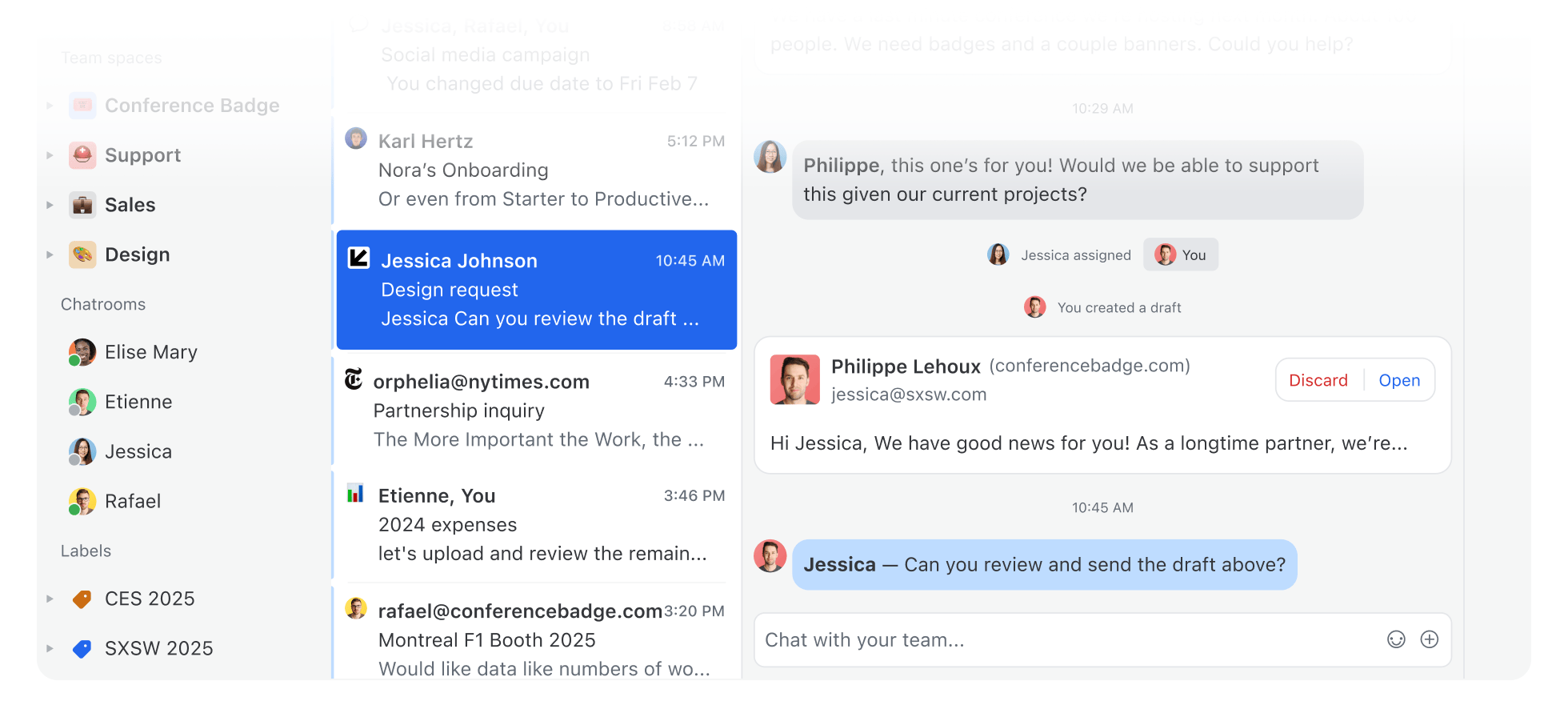
This single feature gives me back several hours per week that I can spend working on the business instead of always in it.
For outside collaborators like an accountant, contractor, or client, Guest Access lets you invite them into specific conversations to chat alongside the email, without paying for another seat.
Price
Missive gives every new team a 30-day free trial, no credit card required. Paid plans are $14 (Starter, up to 5 users), $24 (Productive, up to 50 users), and $36 (Business) per user per month on annual billing, or $18, $30, and $45 billed monthly. See the pricing page for the full comparison.
We’ve been on the Productive plan for a few years now because of the time we save with rules and integrations. Rules, integrations, and the AI assistant start on Productive, so that’s the plan most growing teams should budget for.
Beyond its core features (which work great on mobile, by the way), Missive supports integrations with tools like Trello, Asana, ClickUp, Pipedrive, HubSpot, and Zapier. It acts as our email client, customer support inbox, task system, calendar, and internal communication app, and saves us hours each month.
Trade-off: Missive doesn’t have built-in video calls, so you’ll still want Zoom or Teams for meetings. Live chat runs on your own Twilio account, which is an extra setup step.
2. Slack
Best for: fast internal chat between teammates.
Slack is one of the most common apps businesses of all sizes use to talk in real time or asynchronously. You can message, share files, hop on huddles, and get updates from third-party tools like Google Drive and Gmail.
Slack has channels you can use to separate different types of conversations. For example, you might have a channel only for operations and another only for talking with your CPA.

Price
Slack’s free plan keeps 90 days of message history. Pro is $7.25 per user per month on annual billing ($8.75 monthly), and Business+ is $15 per user per month on annual billing.
If you’re a service business with customers who work with you on long-term projects, you can bring them into shared channels with Slack Connect on paid plans. But if you have a high volume of customers, it’s a logistical nightmare to add them all to Slack, so you’ll still rely on email, live chat, phone, and text. That means more subscriptions and more apps to keep up with so things don’t slip through the cracks.
Trade-off: Slack works best for internal chat. Customer conversations stay in your inbox, which is why many small teams pair Slack with a shared inbox or replace both with a tool that combines email and chat.
3. Microsoft Teams
Best for: businesses already on Microsoft 365 and Outlook.
Microsoft Teams combines chat, video meetings, and file sharing, and it plugs into Outlook, OneDrive, and the rest of Microsoft 365. If your company already pays for Microsoft 365, you may have Teams already.
Price
Teams Essentials is $4 per user per month on annual billing and includes unlimited meetings with up to 300 participants and 10 GB of cloud storage per user. Microsoft 365 Business Basic, which adds business email and 1 TB of storage, is $7 per user per month on annual billing.
Trade-off: Teams is heavier than Slack and feels most at home inside a Microsoft setup. Teams on Google Workspace usually prefer Slack or Google Chat.
4. Zoom
Best for: video meetings with people inside and outside your company.
A few years ago it wouldn’t have been strange to talk to small business owners who hadn’t heard of Zoom. I doubt that’s the case anymore. Zoom hosts video and audio calls, meetings, webinars, and team chat.
Price
The free Basic plan lets you host meetings with up to 100 participants, capped at 40 minutes. You can work around this by having more efficient meetings (something we all need) or scheduling back-to-back meetings. Zoom Workplace Pro removes the limit (up to 30 hours per meeting) and starts at $14.16 per user per month on annual billing, or $15.99 monthly.
Slack supports calls too, but with Zoom you can meet with people who aren’t in your Slack workspace without any setup on their side.
Trade-off: another standalone app to manage, and the free plan’s 40-minute cap gets old fast for client meetings.
5. Loom
Best for: async video, walkthroughs, and training.
Text-based communication is great, but sometimes you need to send a video or screen recording so people don’t misinterpret you. That’s where Loom comes in.
Loom is one of the easiest asynchronous communication tools we’ve tried and outclassed alternatives like Vimeo and Vidyard. Once you finish recording, Loom gives you a link to share so people can watch instead of skimming your email, missing the context, and starting another needless back-and-forth thread.
Price
The free Starter plan includes up to 25 videos per person, 5 minutes each, for up to 50 workspace members. Business removes those limits and costs $15 per user per month on annual billing ($18 monthly).
Trade-off: the 5-minute cap on the free plan is tight for training videos.
6. RingCentral RingEX
Best for: small teams that want business phone, SMS, and video meetings from one provider.
Some small businesses still manage their communication like it’s 2012: one app for calls, another for messaging, another for video meetings, and somehow fax still sneaks into the mix.
RingCentral’s RingEX brings business calling, team messaging, video meetings, SMS, and fax into a single platform, so your team can communicate without constantly switching tabs. It gives you one business number that works on desktop and mobile, which helps a small team come across as more professional.
Price
RingEX starts at $20 per user per month on annual billing (Core) and goes up to $35 per user per month (Ultra). There’s a 14-day free trial.
Unlike chat-only tools like Slack, RingEX was built with voice reliability in mind (RingCentral’s strong suit), and it includes AI features like call summaries and notes. If your team is hybrid or spread across locations, it makes communication a lot less chaotic.
Trade-off: it’s priced like a phone system. If you don’t need business calling, a chat app plus Zoom is cheaper.
Best project management tools for collaboration
I can confidently say I’ve used every popular project management app out there and have yet to find a single one I’d call the best for everyone.
Every company is a little different. What works for a law firm won’t always work for a logistics company, a marketing agency, or a budding Shopify store. You have to figure out which one will work best for your business, your customers, and your team.
I highly recommend reviewing a tool’s public product feedback board before you even sign up for a free trial. You can usually find it by searching for:
- [name of the tool] + feedback
- [name of the tool] + canny board

See which feature requests have been around the longest with a ton of votes, and ask yourself whether you want to invest in a tool that hasn’t delivered what its customers keep asking for.
That being said, here are a few we’ve used and seen other teams succeed with.
7. Asana
Best for: teams that need structured projects, timelines, and recurring workflows.
Asana is one of the most popular task management systems available. It has a free plan, but we quickly realized we needed a paid plan to manage operations and get access to timelines (like a Gantt chart), dashboards, custom fields, rules, and task templates.
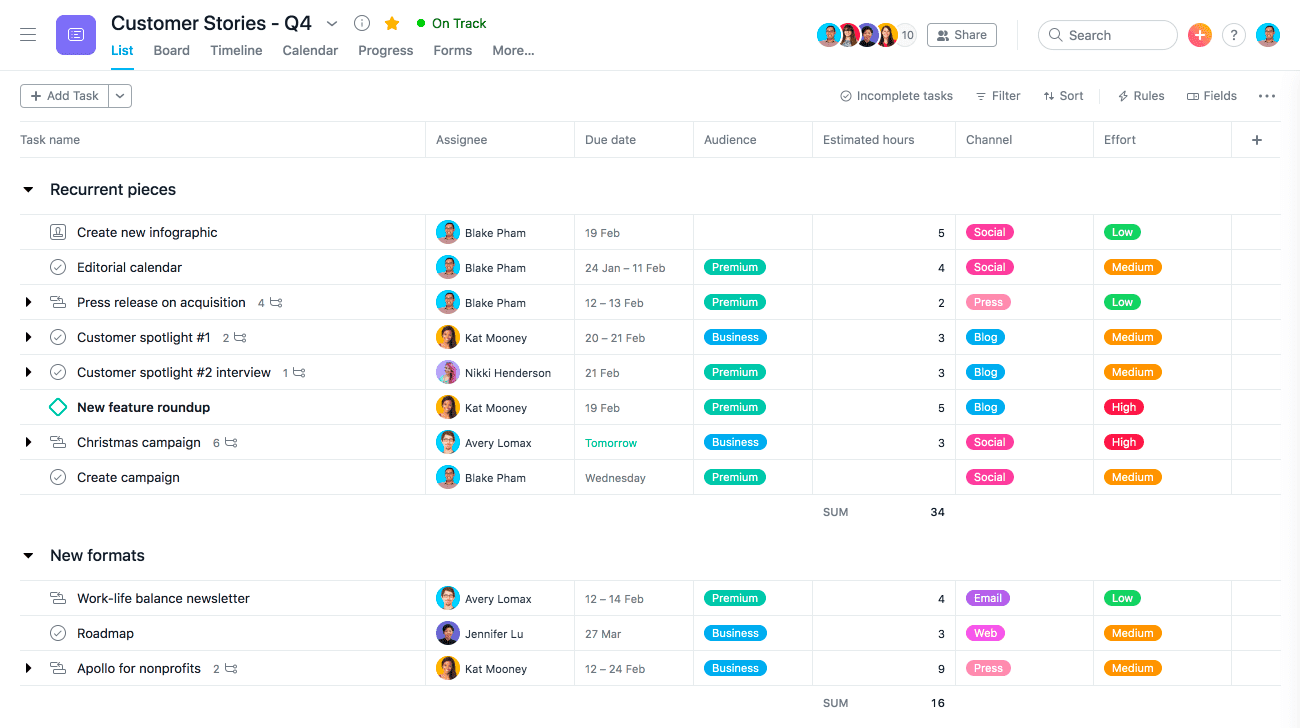
Asana doesn’t have native time tracking on its core plans, so if that matters, you’ll need an Asana time tracking integration like Everhour or Asana’s paid timesheets add-on.
A word of advice: if you use Asana, save yourself some frustration and go light on subtasks. Many features don’t play nice with them, and they work best as a personal checklist.
If you prefer a kanban approach, check out Trello. Asana has a board view, but it’s not nearly as flexible.
Price
Asana’s free Personal plan is meant for individuals. Starter is $10.99 per user per month on annual billing ($13.49 monthly), and Advanced is $24.99 per user per month on annual billing.
Trade-off: paid plans require at least two seats and are sold in seat tiers, so a team of six may end up paying for more seats than it uses. Keep that in mind.
8. ProofHub
Best for: growing teams that want project management without per-user pricing.
ProofHub is an all-in-one project management and team collaboration platform that keeps tasks, files, and project discussions in one place. You can create projects, assign tasks with deadlines and custom fields, and keep the conversation attached to the work instead of scattered across a chat app.
One feature worth calling out is the built-in proofing tool. If your team reviews creative assets like designs or ad mockups, reviewers can leave comments directly on the file instead of describing their feedback over email.
Price
ProofHub’s biggest differentiator is flat-rate pricing. Remember the Asana seat tiers above? None of that here: you don’t pay per user at all. The Essential plan is a flat $45 per month on annual billing for unlimited users and up to 40 projects, and Ultimate Control is $89 per month on annual billing with unlimited projects, custom roles, and priority support. There’s a 14-day free trial.
Trade-off: fewer third-party integrations than Asana or monday.com, so check that the tools you rely on are supported.
9. monday.com
Best for: visual project boards that non-technical teams pick up quickly.
You’ve probably seen their ads. We don’t use monday.com ourselves, but we tested it extensively and passed on it at the time because it didn’t support subtasks (it does now).

Price
monday.com has a free plan for up to 2 seats with 3 boards. Paid plans start at $9 per seat per month on annual billing (Basic), with Standard at $12 and Pro at $19. All paid plans have a 3-seat minimum.
Trade-off: timeline views, guest access, and meaningful automations start on Standard, so most teams outgrow Basic quickly.
Best file and document tools for collaboration
You’re probably already using one of these document collaboration suites:
But you still need a place to share files that don’t live in one of those editors. That’s where a file storage tool comes in.
10. Google Drive
Best for: teams already using Gmail and Google Docs.
Google has one of the best cloud storage options out there, especially for file sharing. You can store documents, pictures, videos, and just about any file type and access them from any device. If you need files offline, Google Drive supports that through its desktop and mobile apps.

Price
A free Google account includes 15 GB of storage shared across Drive, Gmail, and Photos. For business use, Google Workspace Business Starter is $7 per user per month with a one-year commitment ($8.40 on the flexible plan) and includes 30 GB of pooled storage per user plus business email. Business Standard is $14 per user per month with 2 TB per user.
I personally prefer Google Drive over all other options, but that’s because of the Google apps (Docs and Sheets) we use so much day to day.
Trade-off: Business Starter’s 30 GB per user fills up quickly if you store video or design files.
11. Dropbox
Best for: teams that aren’t tied to Google or Microsoft and work with large files.
If you’re not heavily invested in Google’s apps, check out Dropbox. It does the same core job as Google Drive, with strong file sync and large file transfers.
Price
Dropbox Basic is free with 2 GB of storage. Plus is $9.99 per month for one person with 2 TB, and Standard for teams is $15 per user per month on annual billing, starting at 3 TB for the team.
Trade-off: the free plan is much smaller than Google’s, and it gets more expensive than Google Drive as your storage needs scale.
Best marketing and social media tools for collaboration
Marketing is critical to growing your business. People can’t buy from you if they don’t know you exist. For most small businesses, social media is one of the best channels to generate demand, and it’s also the one that benefits most from back-and-forth collaboration.
12. Canva
Best for: creating social posts, flyers, and presentations without a designer.
Canva is one of those tools a company of any size can get a ton of value from. Hiring a graphic designer can be expensive, but with a few YouTube tutorials and 15 minutes, any small business can create professional-looking designs to promote on social media and attract more customers.

Price
Canva Free includes a large library of templates and lets you share designs for feedback. Canva Pro is $144 per year for one person and adds premium templates, AI tools, brand kits, and social scheduling. For teams, Canva Business is $250 per person per year (or $20 per person per month) and adds shared team workspaces, brand controls, and approvals.
The most common reason I’ve seen people upgrade is to schedule posts to social media directly from Canva without paying for another tool like Hootsuite or Sprout Social.
Trade-off: Canva Pro is for one person only, so a team of two or more needs Canva Business.
Best sales and contract tools for collaboration
Most small businesses have fewer than 20 employees, so you might be able to skip this section. If you’re a founder filling the roles of CEO, head of marketing, head of sales, and head of everything else, you don’t need tools to help you collaborate with yourself.
But if you have more than one salesperson, or your salesperson struggles to hand off deals to the people who handle operations, these tools can help.
13. PandaDoc
Best for: proposals, quotes, and contracts that need internal approval and e-signatures.
PandaDoc is useful when you need team collaboration on customizable contracts and sales documents with customers who don’t want to send physical files back and forth like it’s the 20th century.

Real-time editing and approvals
Two people sometimes work on a contract at the same time, especially for a complex agreement with a long-term customer. Once a contract is drafted, I review and approve it before it goes to the customer for legally binding e-signatures.
If the customer requests revisions, they can do it in PandaDoc and chat with us there. That’s far more efficient than redlining a Word document and emailing it back and forth.

Price
PandaDoc’s free eSign plan lets you send 5 documents per month. Starter is $19 per seat per month on annual billing ($35 monthly), and Business, which adds custom quotes, pricing tables, and CRM integrations, is $49 per seat per month on annual billing ($65 monthly).
Trade-off: the CRM and quoting features most sales teams want start on Business.
14. Gong
Best for: sales-heavy companies with several reps running a lot of calls.
Unless your sales process involves more than one rep per opportunity, I can’t think of many CRMs where the collaboration features are worth paying extra for.
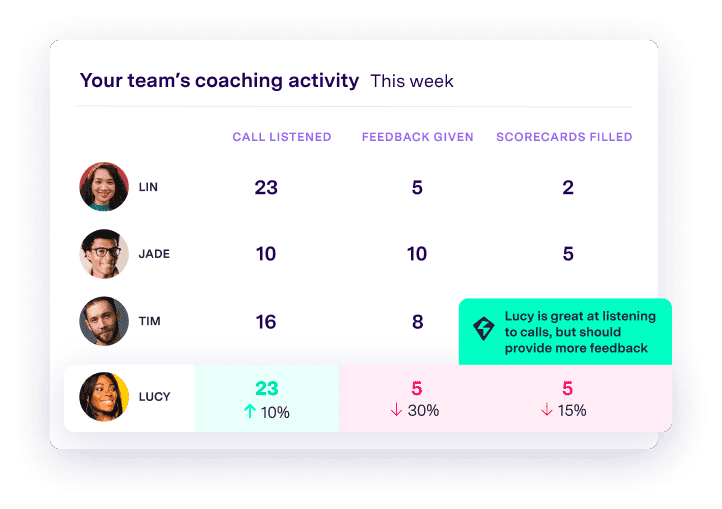
The one truly collaborative tool we use in the sales process is Gong. It’s probably the single most impactful piece of technology we’ve invested in to boost revenue. Gong records and transcribes sales calls and uses AI to surface what’s working and what isn’t, so sales leaders can coach reps and improve close rates.
Price
Gong doesn’t publish pricing. It depends on the number of users and the license type, so you’ll need to contact their sales team.
Trade-off: Gong is built for teams with real call volume. A two-person sales team won’t get its money’s worth.
Bonus: the best tool for collaborating with your accountant
I’ve talked to a lot of small business owners and had quite a laugh when I learned we all deal with the same problem with our accountants:
What was this transaction for $43.52 on February 9th?
Nine times out of ten, I have no idea and have to dig through my email, filter by date, and search for the amount. Doing it once is tedious enough, but it never fails that I spend too long each week helping my accountant classify transactions because some companies don’t use clear statement descriptors.
QuickBooks and other accounting software let you add your accountant as a user, but they aren’t built for collaboration.
Collaborating with your accountant in Missive
This is where I have to recommend Missive once again. You can invite your CPA into specific conversations with Guest Access, which is included in every Missive plan, or set up rules on the Productive plan to automatically share and assign finance-related emails as they arrive.

It’s been months since I’ve had to help my CPA classify transactions. Does it save me a ton of time each month? Probably not. But when you’re already buried under a never-ending to-do list, every little win matters. If you run an accounting firm yourself, here’s how firms set up client work in Missive.
How to choose the right collaboration software for your business
Collaboration tools exist to cut the time your team spends chasing information. They aren’t one-size-fits-all, so start with the problem, not the feature list. Answer these questions before you sign up for anything:
- Where does work get stuck today? Email handoffs, unanswered customer messages, lost files, or unclear task owners each point to a different category of tool.
- Who will use it? Tools for internal chat, client communication, and project tracking have very different users.
- What does it cost for your real team size? Check seat minimums, seat tiers, and the plan you’ll need in six months.
- How much training does it need? If a tool needs days of onboarding, a small team won’t stick with it.
- Does it replace something? The best addition to your stack is one that lets you cancel another subscription.
Once you have a shortlist, use the free trials or request a demo. The most important thing is to choose software your team will actually use. If a tool is too advanced or hard to learn, people will quietly go back to their old habits.
FAQ
What is team collaboration software?
Team collaboration software is any tool that helps people work together on shared tasks, conversations, or files in one place instead of scattering them across email, chat, and spreadsheets. Common categories include team chat (Slack, Microsoft Teams), collaborative email (Missive), video meetings (Zoom), project management (Asana, monday.com), and file sharing (Google Drive, Dropbox).
What is the best collaboration software for small businesses?
There isn’t one tool that covers everything. Most small businesses do best with a collaborative email and chat app for communication (like Missive), a video tool for meetings (Zoom or Teams), a project tool (Asana or monday.com), and shared file storage (Google Drive). If your team lives in email and works with customers, start with communication, since that’s where most handoffs break.
Does Microsoft have a collaboration tool?
Yes. Microsoft Teams is Microsoft’s collaboration tool for chat, meetings, and file sharing. You can buy it as Teams Essentials ($4 per user per month on annual billing) or get it as part of Microsoft 365 business plans, which start at $7 per user per month on annual billing.
What is the best free collaboration software?
Slack, Zoom, Asana, monday.com, Loom, Canva, Google Drive, and Dropbox all have free plans that work for very small teams. Each free plan has a catch, such as Slack’s 90-day message history, Zoom’s 40-minute meetings, and monday.com’s 2-seat limit, so expect to upgrade as your team grows.
How many collaboration tools does a small business need?
Usually three or four: one for communication, one for meetings, one for projects, and one for files. Every extra tool is another place to check, so favor tools that combine jobs, like a shared inbox with internal chat instead of separate email and chat apps.
What are the benefits of collaboration software for a business?
Collaboration software centralizes information so everyone who needs it can find it, reduces duplicated work and errors, and makes it clear who owns what. For small teams, the biggest benefit is fewer dropped balls between people, especially on customer conversations.
Missive brings your team’s email, internal chat, and client channels into one app, so delegating a message takes one @mention instead of a forward. Try Missive free for 30 days, no credit card required.

November 16, 2020
What is Pipedrive?
Pipedrive is a CRM or Customer Relationship Management tool. It that allows companies to properly manage...
Managing leads and deals from an Excel sheet might work for a short period of time, but it's mostly a hack. What your company needs, no matter the size, is a CRM.
A CRM is a Customer Relationship Management tool, usually in the form of an app that allows companies to properly manage interactions with potential and current customers. Companies of all sizes, including small ones, benefit from integrating a CRM into their tool stack.
Options abound online. But we believe Pipedrive is one of the best out there. It's not just a CRM, it helps you, among other things:
- Manage leads and deals
- Track communications
- Automate tasks
- Generate insights and reports

How to manage leads and deals from my inbox?
In one word: Missive.
Missive is a team inbox and chat app that helps businesses stay on top of all their communication channels and projects in a single app. All while enabling collaboration between coworkers. Missive offers a Pipedrive integration that helps you bridge the gap between emails and your sales funnel!
Missive offers a great integration with Pipedrive that lets you see your contacts, deals, activities and notes right in the context of your Inbox! You can also create and edit them directly from Missive.

The integration will also let you quickly send received emails to your Pipedrive account with the Forward to Pipedrive action available on each email.

Do you need to discuss a deal in real-time? No problem, you can do that too using the chat feature in Missive!
How do you set up Pipedrive in Missive?
Step 1
Create a free Pipedrive account.
They offer multiple sign up options, like Gmail or LinkedIn sign in for example, or you can do it with an email and password.
Step 2
Open Missive and go to Settings > Integrations > Add integration > Pipedrive

A pop-up will open that will ask for your Pipedrive account and permission to access it.

Share the integration with your team if needed.

Step 3
You're ready to start adding contacts, deals, activities and notes from Missive!

Will changes reflect in Pipedrive?
Absolutely! Everything you create or edit in Missive will be visible and available in pipedrive.com in real-time.


September 16, 2020
What is Asana?
Asana is a online project management tool. It can help people of all industries better manage projects...
Project management from your email client? It's possible.
Asana is a project management tool that has exploded in popularity in the last few years. It can help people of all industries better manage projects using different visualizations, including Kanban-style boards, calendar view, Gant charts, etc.

Asana can also help your team reduce the number of meetings because it lets you clearly define task owners and allows a high-degree scoping. And although Asana can also reduce the number of emails you get, you simply can't get rid of them all. Email is by far the most used communications medium in the professional world. Customers, clients, prospects, employees, etc., they all use email.
Email is actually the simplest way to communicate externally with clients. There's no learning curve to beat or onboarding to account for. You simply send email.
So there should be a way to easily add tasks to projects in Asana directly from your email, right? Without the hassle of shifting between apps and trying to match tasks with specific conversations.
Thanks to Missive's integration with Asana, you can add tasks to workspaces and projects from your email client with just a couple of clicks.
Sounds good, but what is Missive?
Missive is a team inbox and chat tool that helps businesses stay on top of all their communication channels and projects in a single app. All while enabling collaboration between coworkers. Missive offers an integration with Asana that helps you bridge the gap between emails and project management!
The integration gives you access to all your projects, tags, custom fields, and teammates. You will be able to assign tasks to teammates and define due dates. Say goodbye to switching between apps to add tasks to your workspaces.
A customer sent an email with a change request to the project? Easy, click on New Task in Missive, and the whole team will see the new task and can begin to work immediately.

Do you need to discuss a task in real-time? No problem, you can do that too!

How do you set up Asana in Missive?
Step 1
Create a free Asana account.
Step 2
Open Missive and go to Settings > Integrations > Add integration > Asana
A pop-up will open that will ask for your Asana account and permission to access it.

Share the integration with your team if needed.

Step 3
You're ready to start creating and managing Asana tasks directly from Missive! Click on the New task button in the integrations panel.

Enter the task's information and click on Create:

Will changes reflect in Asana?
Yes! Everything you create or edit in Missive will be visible and available in app.asana.com in real-time.


September 15, 2020
What is Trello?
Trello uses the lean kanban methodology to help people plan and execute projects of all sorts via their...
Sometimes a to-do list is not enough to accomplish your objectives.
More often than not, you need a more structured approach. This is where tools like Trello are of great help. Trello is a web-based app that lets you create cards with lists in a Kanban-style to manage projects.
Kanban is a method of organizing work. It's a visualization format in which cards (digital or not) are spread over a board. Each card contains a task or action. Cards are distributed in different lists in categories of progress: To-do, doing, and done. Boards can be customized to hold different degrees of progress granularization.

Trello uses the kanban lean methodology to help people plan and execute projects of all sorts via their application. Trello boards are very popular. Some companies, organizations and communities leave them public for everyone to watch, like the super popular videogame Project JoJo Trello or this company's roadmap.
Nice! You said something about managing Trello from my email?
Short story long, yes, you can with Missive.
Missive is a team inbox and chat app that helps businesses stay on top of all their communication channels and projects in a single app. All while enabling collaboration between coworkers. Missive offers a Trello integration that helps you bridge the gap between emails and projects!
The integration gives you access to all your boards, lists, labels, cards, and teammates. You will be able to add cards, apply labels, move cards to lists, add teammates, and define due dates. Say good buy to switching between apps to add tasks to your project.
A customer sent an email with a change request to the project? Easy, click on New Card on Missive, and the whole team will see the new task and begin to work immediately.

Do you need to discuss a card in real-time? No problem, you can do that too!

How do you set up Trello in Missive?
Step 1
Create a free Trello account.
They offer multiple sign up options, like Gmail sign in for example, or you can do it with an email and password. Once that's done, you will need to create your first project or board, then add a few cards and you're done!
Step 2
Open Missive and go to Settings > Integrations > Add integration > Trello
A pop-up will open that will ask for your Trello account and permission to access it.

Share the integration with your team if needed.

Step 3
You're ready to start creating and managing cards from Missive! Click on the "New Card" button in the integrations panel.

Enter the card's information and click on Create:

Will changes reflect in Trello?
Yes! Everything you create or edit in Missive will be visible and available in trello.com in real-time.
