Bring all client, vendor, and internal messages into one place. Easily assign work, reply faster, and reduce double-work across shifts, departments, and teams.
Automation that works how you do
Auto-route incoming messages to the right people. Trigger alerts, apply labels, assign jobs, and integrate with your CRM, TMS, or internal dashboards.
Multi-channel and on all devices
Bring in your WhatsApp, SMS, and more, into Missive. Your team can add photos, delivery receipts and estimates into conversations on the go. Available on all platforms, including mobile.
Track SLAs and response times
Stay on top of service commitments. Missive makes it easy to measure responsiveness and ensure no request goes unanswered, even in high-volume environments.
Shared inboxes for dispatch and support
Bring all client, vendor, and internal messages into one place. Easily assign work, reply faster, and reduce double-work across shifts, departments, and teams.
Automation that works how you do
Auto-route incoming messages to the right people. Trigger alerts, apply labels, assign jobs, and integrate with your CRM, TMS, or internal dashboards.
Multi-channel and on all devices
Bring in your WhatsApp, SMS, and more, into Missive. Your team can add photos, delivery receipts and estimates into conversations on the go. Available on all platforms, including mobile.
Track SLAs and response times
Stay on top of service commitments. Missive makes it easy to measure responsiveness and ensure no request goes unanswered, even in high-volume environments.
“We’ve tried so many shared inbox solutions. Missive was unexpectedly powerful. Suddenly, we weren’t scrambling over lost emails or letting days slip by.”
Key features for service operations, logistics, and field teams
Team inboxes with assignment & visibility controls
Know who’s working on what at any time.
Collaborative chat in every email thread
Discuss internally, then send.
Rules and automations for routing and reminders
Built for handling high volumes of emails.
Omnichannel support (email, SMS, chat, and more)
Manage multiple channels from the same inbox.
Custom integration with your TMS
Using Missive’s API you can pull context into one place.
A better alternative to traditional helpdesks
Helpdesk Tools
Missive
Personal replies
Ticket-based, robotic
Feels like real email
Internal collaboration
Basic notes
Chat, tagging, & assignments
Multi-device support
Limited mobile apps
Same power, on every device
Integrations
Limited or clunky
Custom triggers & automations
What operations leaders are saying
4.8
→ Over 1000 reviews
It's the one inbox tool you'll ever need: great features, excellent customer support, and competitive pricing. Migrating from the platform we initially were using was easy because of how intuitive using the tool is. You are given freedom to decide how to make use of the "teams" system they have, which means you can easily tailor the system to fit your needs. Without having to jump from one tool to the next, we are able to respond to customer messages, emails, leave notes for other members of the team, and even assign tasks to each other.
Hard to say what is best, because we love everything really. Assigning emails to team/team member, shared signatures and responses are hugely helpful and very customizable. The integrations are great. One of the biggest game changers was being able to make a single email into a shared email just in Missive. I have also had a good deal of correspondence with customer support and they are absolutely incredible. Every response I get is well thought out, extremely specific, and answers my questions.
We are a shipping services company, so we have a lot of email on a daily basis. We have tried many email management programs, but we have chosen Missive because it is the most powerful of all the ones we have tried. It's a whole platform for organizing emails as it includes calendar services, to-do lists, email assignment & comment systems, rooms (chat), pins, labels (tags) and a whole bunch of other add-ons that you can put in to customize it the way you want it. It is also very responsive as it can easily be used on mobile devices.
Revolutionize your inbox with Missive's AI Rules, where artificial intelligence meets your workflow to automatically sort, respond, and organize emails based on what they actually contain.
We've all been there. You open your inbox on Monday morning and face an avalanche of messages. Some need immediate attention. Others could wait. Many should be handled by different team members. And a surprising number don't need any response at all. While Missive's rule engine has always given you the flexibility to automate your workflow exactly how you want it, today we're taking that customization power to a whole new level.
What if your inbox could sort itself? What if it could understand what each email is about and take the right action automatically—all while you maintain complete control over how it behaves? What if you could define exactly how your emails are processed, based not just on who sent them, but on what they actually contain?
Today, we're launching AI Rules in Missive - a simple way to bring the intelligence of AI to your email workflow without the complexity. It's the same flexible rule engine you love, now with the power to understand email content the way you do.
What are AI rules?
AI Rules are an extension of Missive's existing rules engine. If you've used rules before, you know they're powerful for automating repetitive tasks based on simple conditions like sender address or subject line keywords.
Now, we're adding the ability to use AI to understand what an email is actually about.
Here's how it works:
You create a rule with an "AI Prompt" condition
You write a simple instruction for the AI
The AI reads the email and gives an answer
Your rule takes action based on that answer
No training data. No complicated setup. Just plain language instructions that the AI follows.
Real examples, real time saved
Let's look at some practical ways teams are already using AI Rules during our beta:
- A ⛑️ customer service team set up a rule that using this prompt:
Is this customer angry or upset? Respond with ONLY "YES" or "NO".
If the AI says YES, the email gets flagged as high priority and assigned to a senior agent.
- A 📈 sales team created a rule with this prompt:
Is this a qualified sales lead or just a general inquiry? Respond with ONLY ONE of these exact words: "sales lead" or "general inquiry".
Leads go straight to the sales pipeline, while general questions route to the support team. Their sales reps now spend more time selling and less time triaging emails.
- A ⚖️ legal firm uses AI to detect if an email contains a deadline or time-sensitive request.
Does this email contain a deadline, due date, or time-sensitive request? Respond with ONLY "YES" or "NO".
If it does, it gets tagged "Urgent" and triggers a notification and creates tasks. They haven't missed a filing deadline since.
The best part? These teams didn't need to become AI experts. They just wrote simple instructions in plain English.
One prompt, multiple rules
One of the most powerful features of AI Rules is the ability to use the same prompt across multiple rules. This lets you create sophisticated email triage systems without duplicating your AI analysis costs.
For example, you could recreate Gmail's smart categories with more flexibility and control.
First, create a prompt that categorizes emails:
Analyze this email and respond with EXACTLY ONE of these categories:
"SOCIAL" - for messages from social networks, dating sites, etc.
"PROMOTIONS" - for marketing emails, offers, discounts, newsletters
"UPDATES" - for notifications, confirmations, receipts, statements
Then create separate rules, all using this exact same prompt but with different matching conditions:
On rule per category
Rule 1: Social
The beauty of this approach is that the AI only analyzes each email once, even though you have six different rules. The result is cached and reused across all rules, making this both efficient and cost-effective.
And unlike Gmail's fixed categories, you have complete control over:
What categories to use
What actions to take for each category
How to prioritize different types of messages
When to apply these rules (you could add additional conditions)
This is just one example of how you can use AI Rules to create a customized workflow that fits exactly how you and your team want to work.
Four ways to use AI in your rules
We've built four powerful AI capabilities into Missive:
1. AI Conditions
As shown above, use AI to analyze email content and make decisions. The AI can detect sentiment, identify request types, or extract specific information that would be difficult to capture with traditional keyword rules.
For example: "Is this customer angry?" or "Does this email contain a deadline?"
2. AI-Generated Posts
Have the AI create a helpful note about an email. The AI can summarize long threads, extract key points, translate emails or provide context for your team.
e.g.
Translate the email to English.
3. AI-Generated Tasks
Let the AI identify action items in emails and automatically create tasks. No more manually creating to-dos from your messages. For example:
Extract any tasks or action items from this email and create a task for each one.
4. AI-Generated Drafts
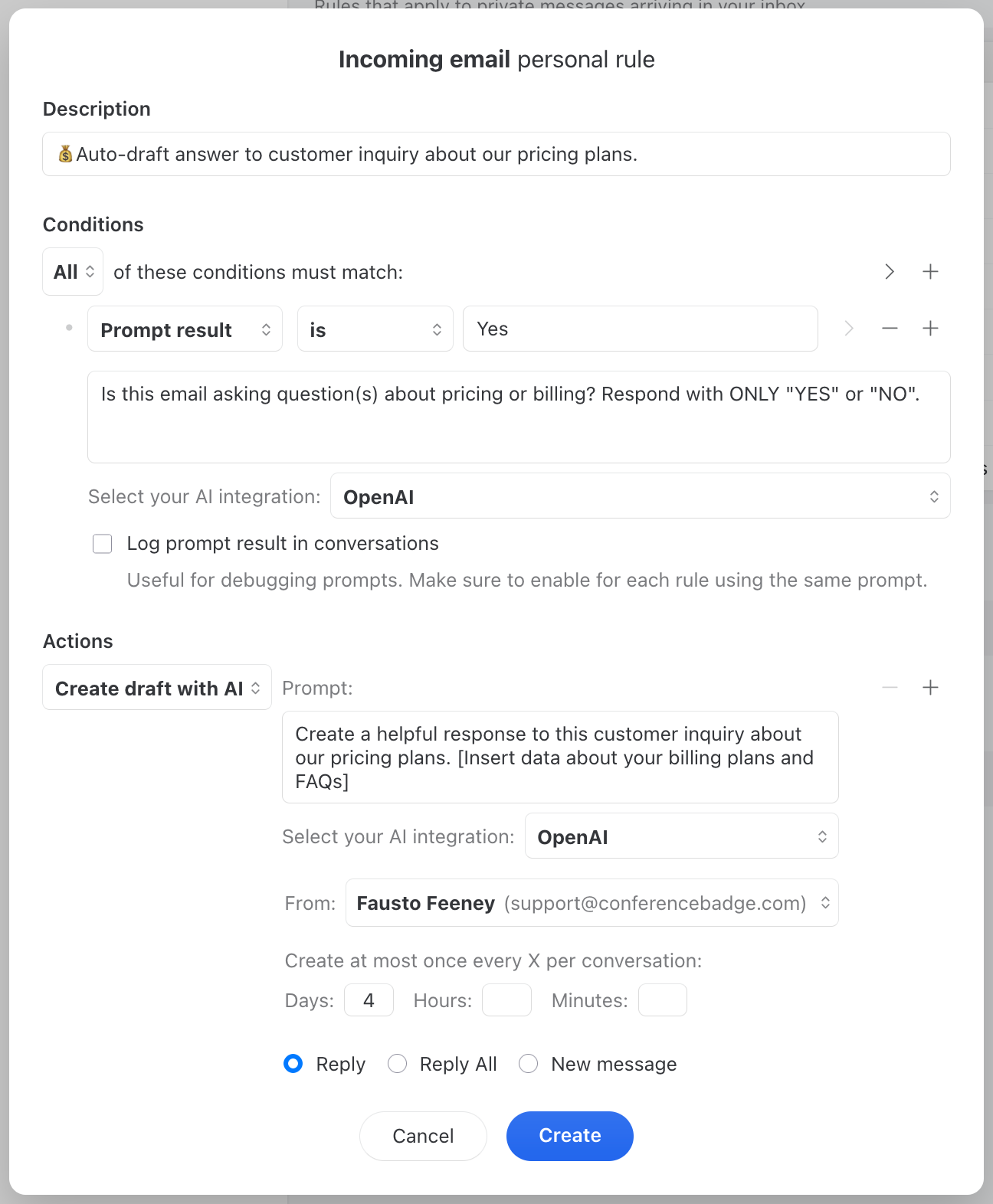
Automatically create response drafts for common inquiries. The AI can craft a personalized reply based on the email content, which you can review and send with a click:
Create a helpful response to this customer inquiry about our pricing plans.
The above draft example could be paired with an AI condition that makes sure the email is about billing!
Simple to set up, powerful in practice
We've worked hard to make AI Rules approachable. You don't need to be a prompt engineer or AI expert to get value from day one. The system uses gpt-4o-mini, which offers an excellent balance of speed, cost-effectiveness, and quality for email processing.
Your data, your control
We understand that email contains sensitive information. That's why:
You connect your own OpenAI account
You control exactly which emails get processed by AI
Email content is only sent to OpenAI at the moment of rule processing
No data is stored by OpenAI beyond what's needed for the immediate request
The inbox you've always wanted
For years, we've been building tools to help teams manage email more efficiently. Rules have always been at the heart of that mission - letting you automate the repetitive stuff so you can focus on the work that matters.
AI Rules take that automation to a new level. Now your inbox doesn't just sort emails based on simple patterns - it understands what they're about and what needs to happen next.
This isn't about replacing human judgment. It's about removing the tedious parts of email management so your team can focus on what humans do best: building relationships, solving complex problems, and delivering value to your customers.
AI Rules are available today for all Missive users on the Productive plan and above. Give them a try, and let us know what you think.
Your inbox will thank you.
Frequently Asked Questions
Want to learn more about AI Rules? Check out these helpful resources:
Five underused Missive features that quietly save the most time: merging threads, a custom sidebar, inline canned responses, the command bar, and custom thread names.
Five Missive features that quietly save the most time once you actually use them: merging email threads, customizing your sidebar, inserting canned responses inline with #shortname, the command bar (Cmd/Ctrl+K), and renaming threads so they make sense at a glance. Most people know Missive has these. Fewer people build them into their daily workflow.
When I started my career, my first experience with team email was chaotic. Multiple inboxes, scattered conversations, constant back-and-forth about who was handling what. It was a nightmare.
At my last job, we used Missive, and it was night and day compared to my previous experience. But it wasn’t until I discovered some of the hidden features that things really clicked for me.
Over the past few years I’ve used Missive daily, and for the last year I’ve been helping Missive customers uncover the hidden gems. Today I want to share the five features that transformed how I handle communication. These aren’t the flashy ones, they’re the practical, everyday tools that make a real difference.
1. Merging email threads
You know when someone starts a new email thread about something you’re already discussing in another thread? This used to drive me crazy. In Missive, you just drag one conversation onto the other and they merge into a single thread. Everything stays in order, nothing gets lost, and suddenly all your context is in one place.
Merge two conversations into a single one.
Where this shines:
A customer replies to an old email instead of the original thread for the same issue
Multiple customers reporting the same issue
Getting quotes from different suppliers
Project discussions that branch off and need to be reconnected
Pro tip: You can’t undo a merge, but you can move messages out of a merged conversation into new private or shared ones.
2. Your sidebar, your rules
Customizing your sidebar might not sound revolutionary at first, but trust me: it’s like finally organizing your desk after years of chaos.
What makes it special:
Move your most-used mailboxes to the top
Hide the stuff you rarely touch
Group things however they make sense to YOU
Create separate sections for different projects or clients
Customize the sidebar to your liking.
How different teams use this:
Support teams:
Support Team Inbox at the top
Urgent issues section with labels
Team chat of the Support team
Archived mailbox hidden but accessible
Sales teams:
Hot lead labels front and center
Separate sections for each pipeline stage
Quick access to Sales team room
“Follow-up” label pinned
Project managers:
Project-specific inboxes grouped
Client communication sections
Team room easily accessible
Deadline-sensitive items labels
Pro tip: You can also create whole new sections. Just drag an item on top of the +More button in the sidebar.
3. Type # and save hours
This feature is genuinely powerful: inserting canned responses inline. Do you know what I mean?
Type a hashtag followed by your response name, and boom, your full message appears right where you’re typing. No more copying and pasting, no more digging through templates.
#hi: Personalized welcome messages for new email requests
#followup: “Thanks for reaching out”
#lmka: “Let me know if you need anything else, I’d be happy to help”
#meet: Inserts a link with my Calendly availability
#thanks: Thank-you messages with next steps
Power user tips:
Create variations of common responses (formal vs. casual)
Include variables for personalization
Set up team-wide responses for consistency
Use short, memorable hashtags for the ones you use most
Create responses in multiple languages
4. The command bar (Ctrl/Cmd + K)
If you learn one keyboard shortcut in Missive, make it this one. Press Cmd+K on Mac (or Ctrl+K on Windows) and you’ve got instant access to pretty much everything.
One shortcut to rule them all.
Things you can do from the command bar:
Create new emails, events, or tasks
Access settings and preferences
Switch between 1:1 rooms
Search for specific messages
Manage rules and labels
Open contact books
Set a status
And much more
If I time-track myself for a week with and without using the command bar, the difference is about 3 minutes saved each day just from reducing mouse usage and menu navigation. Compound that over a year and it adds up fast.
5. Custom thread names that actually make sense
This last one is simple but brilliant. You can rename email threads to whatever you want.
Instead of: Re: D-001-2 Ext. Non-Variable → You can call it: Partnership with Titan
Include priority levels (“URGENT: Server Issue Resolution”)
Add dates for time-sensitive stuff (“Q4 Planning - Due Oct 30”)
Tag conversations by department (“HR: New Hire Onboarding - Sarah”)
Putting it all together: power user workflows
The real magic happens when you combine some of these features.
Handling an inbound request from big leads:
Pin your “Big Leads” label to the sidebar
Merge all email communication and Calendly invites into one thread
Use the command bar for quick navigation between your other tasks
For support teams, try this workflow:
Merge support requests from the same customer
Rename threads with issue types and status
Use canned responses for common solutions
Organize the sidebar by priority levels
The impact on your daily work
Depending on your use case, after implementing these features across your team:
Email response time drops by a few minutes per day
Context switching goes down
Team coordination improves
Getting started
Don’t try to implement everything at once. Start with the feature that addresses your biggest pain point:
Drowning in split conversations? Start with merging
Spending too much time on repeated responses? Focus on inline canned responses
Can’t find anything? Organize the sidebar
Lost in endless threads? Start renaming conversations
Give them a shot. Start with one, get comfortable, then move on to the next. You might be surprised at how much time you save. For more on how Missive fits into team email workflows, see our guide to shared inboxes.
Use Claude to draft faster, more consistent customer email responses, without sacrificing quality or your brand voice.
The problem with customer email at scale
You know the pattern. A customer emails asking about your return policy, and you write a thoughtful reply. An hour later, someone else asks the same question, and you write it again, slightly differently this time. By the end of the week, four different teammates have answered the same question four different ways, and now your customers are getting inconsistent information.
This is the daily reality for most small and mid-size teams handling inbound email. The questions are predictable, the answers exist somewhere in your head (or scattered across docs and past replies), and yet every response still takes manual effort. You can’t hire fast enough to keep up, and canned responses feel robotic.
Claude, Anthropic’s AI model, is particularly well-suited to this problem. It’s strong at following nuanced instructions, adapting tone, and handling the kind of unstructured, context-heavy communication that customer email requires. Here’s how to set it up in a way that actually works for a team.
Before you prompt anything: figure out what to automate
The biggest mistake teams make with AI email is jumping straight to “write me a reply.” Before you touch a prompt, spend an hour looking at your inbox. You’re looking for the 20% of question types that make up 80% of your inbound volume.
Pull up your last 50–100 customer emails and sort them into rough categories. You’ll likely find clusters like:
The first five categories are strong candidates for AI-assisted drafting. The last one, complaints and escalations, generally needs a human touch, at least for the initial response. We’ll come back to what you should not automate later.
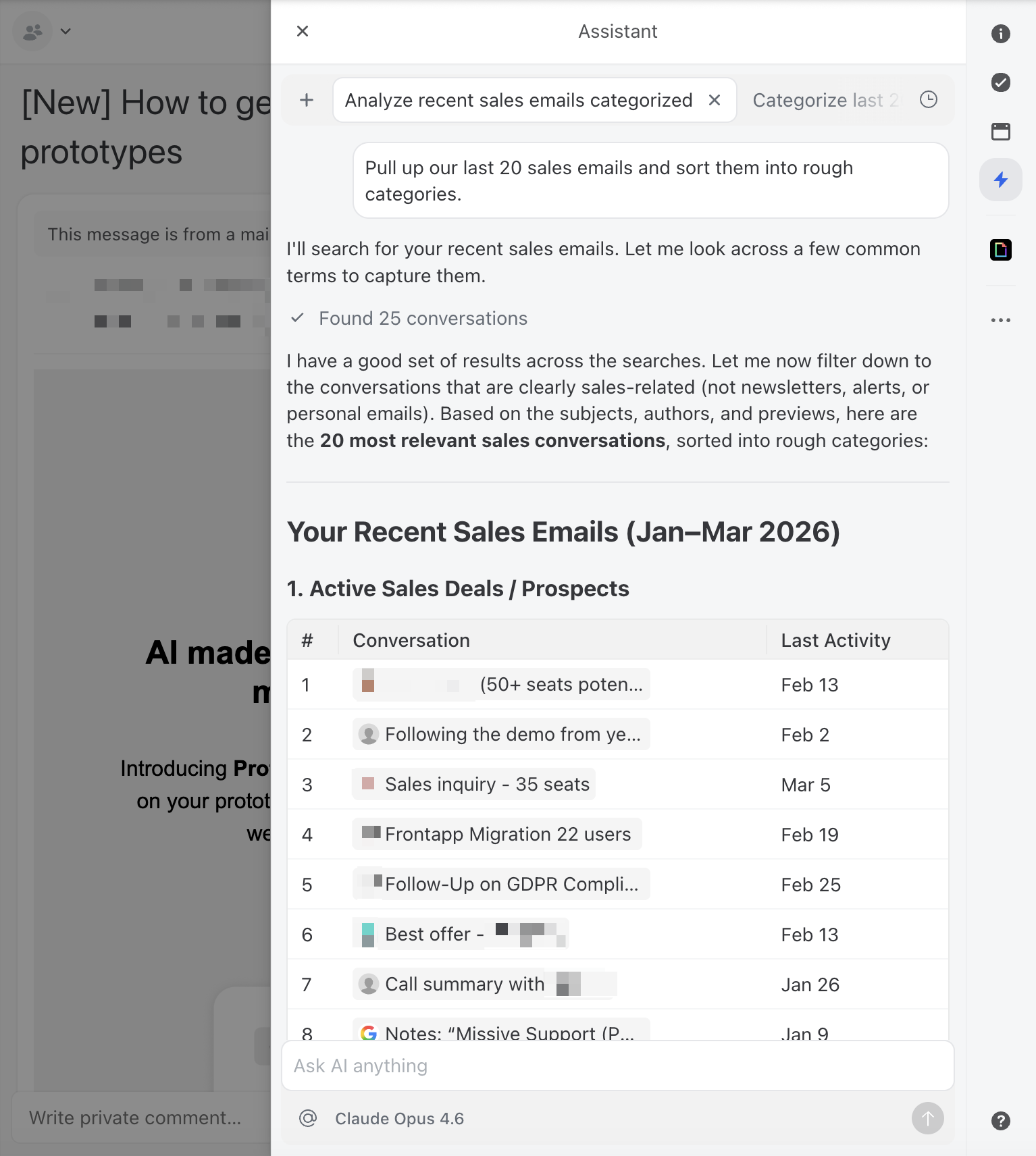
If you use a team inbox tool like Missive, you can actually ask the AI assistant to do this analysis for you. Ask it to find recent conversations and categorize the types of inquiries. It’s a good first test of Claude’s usefulness before you build anything more structured.
Teaching Claude your voice
Claude is good at writing. The problem is that it’s good at writing like Claude, helpful, slightly formal, and generic. Your customers can tell the difference between a human reply and a default AI reply, and that gap erodes trust fast.
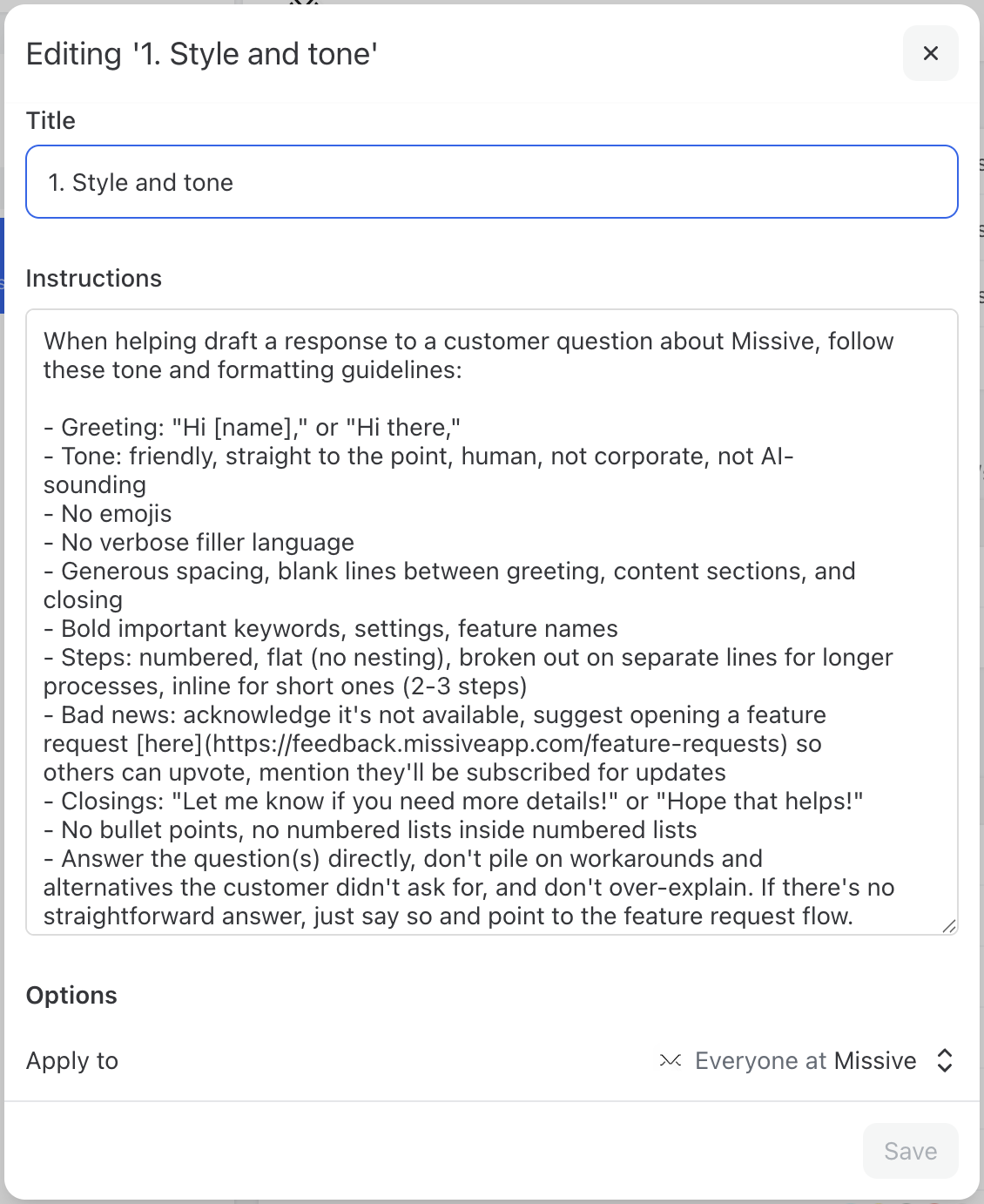
The fix is a set of written instructions that define your communication style. Think of it as a style guide specifically for AI. This doesn’t need to be long, a few clear paragraphs work better than a multi-page document.
A good style instruction covers:
Here’s a practical tip: if you’re not sure how to articulate your style, gather 10 or so of your best customer email replies—the ones where you thought “yes, that’s exactly how we should sound.”
Paste them into a session with Claude and say:
Here are examples of customer emails that represent our ideal tone and style. Can you analyze these and create a style guide I can use as AI instructions?
Claude will pick up on patterns you might not even consciously notice, your sentence length, how you open and close emails, whether you use contractions, how you handle bad news. From there, you go back and forth to refine until it feels right.
In tools like Missive, you can scope AI instructions to specific team inboxes, so your support team gets one set of drafting guidelines and your sales team gets another. This means the AI adapts its voice depending on which inbox the conversation lives in, without anyone having to think about it.
Building prompts that actually work
With your style guide in place, the next step is creating prompt templates for your most common inquiry types. A good prompt has three components: context about your business, the specific task, and constraints on the output.
Here’s a general template you can adapt:
You are a customer support specialist at [Company Name]. We [one sentence about what you do]. The customer has written to us with a question. Draft a reply that: - Directly answers their question using the information below - Matches our company tone (warm, professional, concise) - Includes a specific next step for the customer - Keeps the response under [X] sentences. Relevant information: [Paste your FAQ answer, policy details, or product information here]. If the customer’s question is ambiguous or you’re not confident in the answer, say so clearly rather than guessing. Flag it for human review.
Notice the last line. This is important. Claude is generally good about not fabricating information when explicitly told not to, and that instruction acts as a safety net. You want the AI to surface uncertainty rather than confidently give a wrong answer.
For recurring question types, create dedicated prompts. Here are two examples:
Prompt: Pricing inquiry
A customer is asking about our pricing. Draft a reply using these details: [Your pricing tiers, what’s included, any current promotions]. Be specific about what each tier includes. If they haven’t told us which tier they’re interested in, ask a clarifying question. Don’t volunteer discounts unless they specifically ask.
Prompt: Shipping and delivery
A customer is asking about shipping. Draft a reply using these details: [Your shipping options, typical delivery times by region, tracking process]. If they’ve provided an order number, reference it. If they haven’t, ask for it so we can look up the specific status. Be honest about timelines—don’t promise faster delivery than our standard windows.
Store these prompts somewhere your whole team can access them. Some team inbox tools let you save prompts as reusable one-click actions, this is ideal because it removes the friction of finding and pasting the right prompt every time.
The workflow: how this looks day to day
The goal isn’t to remove humans from the loop. It’s to change the human’s job from writing replies to reviewing them. Here’s what a good AI-assisted email workflow looks like:
Customer emails in. The message lands in your shared inbox.
Team member triggers AI draft. They select the appropriate prompt (or type a specific instruction) and Claude generates a draft reply with full conversation context.
Review and edit. The team member reads the draft, adjusts anything that's off, adds personal touches, and corrects any inaccuracies.
Send. The response goes out, faster than writing from scratch, more consistent than everyone freestyling.
Team learns. When a draft needs significant edits, that's a signal to improve the prompt or add information to your instructions.
The review step is non-negotiable, especially early on. Even a well-prompted Claude will occasionally miss context, use slightly wrong terminology, or misjudge the situation. The review step catches these issues before they reach your customer.
This is actually why Missive’s AI assistant only drafts emails, it never sends them automatically. That’s a deliberate design choice, not a limitation. AI is good, but it’s not perfect. It can hallucinate details, misread tone, or confidently answer a question with outdated information. By keeping a human between the AI draft and the send button, you get the speed benefits of AI without the risk of a bad reply landing in a customer’s inbox. Some tools let AI fire off emails unsupervised. We think that’s a mistake, at least for now.
In a team setting, this is where collaborative tools earn their keep. If you’re working in a shared inbox, a teammate can comment on a draft internally “actually, this customer already reached out about this last week, add a note acknowledging that”, before anyone hits send. The AI draft becomes a starting point for collaboration, not a black box.
What this looks like in Missive
To make this less abstract, here’s how this workflow plays out in practice using Missive’s AI assistant with Claude.
Say a customer emails your shared inbox asking whether your product integrates with their project management tool, and whether that’s included in their current plan. It’s the kind of question your team gets several times a week—not complex, but it requires pulling together information from a couple of different places.
In Missive, a team member opens the conversation and launches the AI assistant in the sidebar. The assistant already has the full conversation context, not just the latest email, but any previous messages in the thread and any internal chat your team has had about this customer. It can also look up contact details to add context about who you’re emailing.
The team member selects a saved prompt like “answer product question” and the assistant drafts a reply. Because you’ve set up team-wide style instructions, the draft automatically matches your tone. Because you’ve built a prompt that includes your integration details and plan breakdowns, the response is specific and accurate.
The team member scans it, tweaks one line, and sends, total time maybe 30 seconds instead of five minutes of digging through docs.
Now here’s where it gets more interesting. Missive is rolling out support for MCP (Model Context Protocol), which means the AI assistant will be able to connect directly to your external knowledge sources—your Google Docs, product database, CRM, help center, or any other tool that supports MCP. Instead of pasting product details into your prompts manually, the assistant will pull that information on its own when it needs it.
For the integration question above, that means the AI wouldn’t just rely on what you’ve written in the prompt template or even what's in your inbox. It could check your documentation, cross-reference the customer’s plan in your CRM, and draft a response that’s accurate to what’s true right now, not what was true when you last updated the prompt.
The human still reviews and sends, but the draft requires less editing because the context is richer.
This is the trajectory: start with saved prompts, style instructions, and inbox context today, and as MCP rolls out, progressively connect more of your tools to have a meaningfully helpful AI agent.
Connecting Claude to your knowledge
The prompts above work when you paste relevant information directly into them. But the real unlock is when Claude can access your knowledge base automatically—your FAQ documents, product guides, policy pages, and past conversations.
There are a few ways to approach this, depending on your technical setup:
Manual context: Copy and paste relevant docs into your prompt or AI sidebar. Low effort, surprisingly effective for small teams. Thisis where most teams should start.
Connected documents: Some tools let you link Google Docs, PDFs, or other files so the AI can reference them when drafting. This isthe sweet spot for teams that have their knowledge organized butdon't want to build custom integrations.
API and MCP integrations: For teams with developers on staff, the Model Context Protocol (MCP) allows Claude to pull from externaldata sources — your CRM, helpdesk, internal wiki, or even a vectordatabase like Pinecone — in real time. This is the path toward the"90–95% accurate AI rep" that requires minimal human editing.
Start with manual context. Get comfortable with the quality of Claude’s output. Then move toward connected docs or MCP as your volume and confidence grow. The mistake is over engineering the integration before you’ve validated that the prompts and instructions produce good results.
Where to keep a human in the loop
Not every customer email should get the same level of AI autonomy. For routine inquiries, a quick scan of the draft before hitting send is usually enough. But some situations deserve more careful human review, and knowing where to draw that line is what separates teams that use AI well from teams that damage customer relationships with it.
Give these extra attention before sending:
Angry or escalated customers. AI can still draft a starting point here, but a frustrated customer can tell when they're getting a generic response. Have someone read the draft carefully, add genuine empathy, and adjust the tone before it goes out. That said, AI can also playa role in routing, tools like Missive let you set up AI rules that detect frustrated or escalated language and automatically assign the conversation to a manager or senior team member, so nothing slips through the cracks.
Complex or ambiguous situations. If the email requires judgment—interpreting a contract, making an exception to policy, handling a sensitive personal situation—AI can help you organize your thoughts or pull together relevant context, but a human should write or heavily edit the final response.
High-value relationships. Your biggest clients or most important partners deserve extra care. AI can help you research and prepare a draft, but give it a thorough personal edit before sending.
Anything involving legal, medical, or financial advice. Claude is not qualified to give professional advice, and neither is anAI-generated email that sounds like it is.
A practical rule of thumb: if you’d hesitate to send the email without reading it twice, that’s a sign the AI draft needs more than a quick glance before it goes out.
Getting your team on board
Rolling out AI-assisted email to a team is as much a people challenge as a technical one. Here’s what works:
Start with one person. Pick the team member who's most comfortable with AI (or most overwhelmed by email volume) and have them pilot the workflow for a week. Collect their feedback beforerolling out to everyone.
Show, don't mandate. Demo a real example: "here's an email that took me 8 minutes to write, and here's Claude drafting a comparableresponse in 15 seconds." Time savings are visceral.
Make the prompts accessible. If people have to remember prompt syntax or go find a document, they won't use it. One-click promptsin a shared library eliminate friction.
Create a feedback loop. When someone edits an AI draft significantly, capture what they changed and why. Use that to improve your prompts and instructions. This is how the system gets better over time.
Measuring whether it’s working
Don’t just assume AI is helping, measure it. The metrics that matter:
Response time: Are you replying faster? This is usually the first and most dramatic improvement.
Draft acceptance rate: What percentage of AI drafts get sent with minimal edits? If you're rewriting most drafts, your prompts orinstructions need work.
Customer satisfaction: Are your CSAT scores or reply quality holding steady (or improving)? AI should raise the floor of response quality, not lower the ceiling.
Volume handled per person: Can each team member handle more conversations per day without burning out?
Check these monthly. The first week will be rocky as you refine prompts and learn what Claude handles well. By week three or four, you should see a clear pattern of which inquiry types Claude nails and which still need heavy human involvement.
Most teams see the biggest gains in response time—cutting average reply time from hours to minutes on routine inquiries. Draft acceptance rate is the metric to watch over time: if 70–80% of AI drafts are going out with only minor tweaks, your prompts and instructions are in good shape.
Frequently asked questions
Can Claude send emails automatically, or only draft them?
In most setups, Claude drafts responses that a human reviews before sending. Fully automated sending is technically possible through API integrations, but we’d strongly recommend against it for customer-facing email, at least until you’ve validated accuracy over hundreds of drafts and have solid error handling in place.
Which Claude model should I use for customer emails?
It depends on the task. Claude offers three model tiers, and each has a sweet spot:
Claude Haiku: fastest/cheapest, good for categorization, translation, quick replies
Claude Sonnet: best all-around for daily email drafting, balances speed/cost/quality
Claude Opus: most capable, best for complex multi-part replies and sensitive comms
How do I teach Claude my company’s tone of voice?
Write a style instruction document (see the “Teaching Claude your voice” section above). The key is being specific about what you don’t want as much as what you do. “Don’t use exclamation points” is more useful than “be professional.” Feed this into your AI tool’s instruction settings so it applies to every interaction.
Is it safe to use Claude for emails containing customer data?
This depends on your AI provider setup. When you connect Claude through an API key, requests go through Anthropic’s infrastructure. Review Anthropic’s data retention and privacy policies, they offer options for zero data retention on API calls. If you’re in a regulated industry, check with your compliance team before sending customer PII through any AI service.
What types of customer emails should I NOT use Claude for?
Escalations, complaints, legal or compliance-sensitive matters, and high-value relationship management. As a rule: if the email requires judgment, empathy, or carries significant risk if handled poorly, keep it human. Use AI for the predictable, repeatable inquiries that eat up your team’s time.
How to create rules in Outlook across every version (new, classic, Mac, web), plus what Outlook rules can’t do and when to use team alternatives.
To create a rule in Outlook, open Settings → Mail → Rules (or File → Manage Rules & Alerts in classic Outlook), click Add new rule, set a condition like “From [sender]” or “Subject includes [keyword],” then pick an action like “Move to folder” or “Delete.” Save, and Outlook will run the rule on every new message that matches.
Outlook rules are the built-in way to automate what happens to incoming email. They can file messages into folders, flag important senders, delete newsletters, or trigger alerts. But the exact setup is different in each version (new Outlook for Windows, classic desktop, web, and Mac), and there are a few limitations worth knowing before you invest time building them.
This guide walks through the steps for every version, what rules can and can’t do, and when a different tool is a better fit.
Understanding the basics of Outlook rules
Think of Outlook rules as a set of “if this, then that” instructions for your email. You tell Outlook what to look for in a message, and it automatically does something specific.
The goal is simple: save time, cut down on the mental energy a cluttered inbox drains, and make sure you never miss an important message.
Not all Outlook rules are the same, though. There’s a meaningful difference between server-side and client-side rules, and it can affect whether your automation runs when you’re away from your computer.
Server-side rules: These run directly on the email server (like Microsoft Exchange). They work 24/7, even if your Outlook app is closed. They’re good for filing messages into folders or auto-forwarding. The new Outlook for Mac only supports server rules, which keeps things simple but cuts some options.
Client-side rules: These only run when the classic Outlook application is open on your computer. They handle actions that need your local app, like playing a sound or showing a desktop alert. If Outlook is closed, your client-side rules are on pause too.
Rules are processed in the order they appear in your list, which can cause weird conflicts. A rule that moves emails from your boss to a “VIP” folder might fight with a rule that moves anything with the word “report” to a “Reports” folder. What happens when your boss emails you a report? To prevent that, Outlook has a “Stop processing more rules” option to make sure only the first matching rule fires.
One last thing: storage. Exchange Online limits the total space for all your rules to just 256 KB per mailbox. Once you hit that ceiling, you can’t create or update any more rules. It sounds like a technical detail, but for power users with dozens of workflows, it’s a surprisingly low limit.
How to create rules in Outlook (for every version)
The exact steps depend on which version of Outlook you’re using.
New Outlook for Windows and Outlook.com
The new desktop app and the web version work the same way.
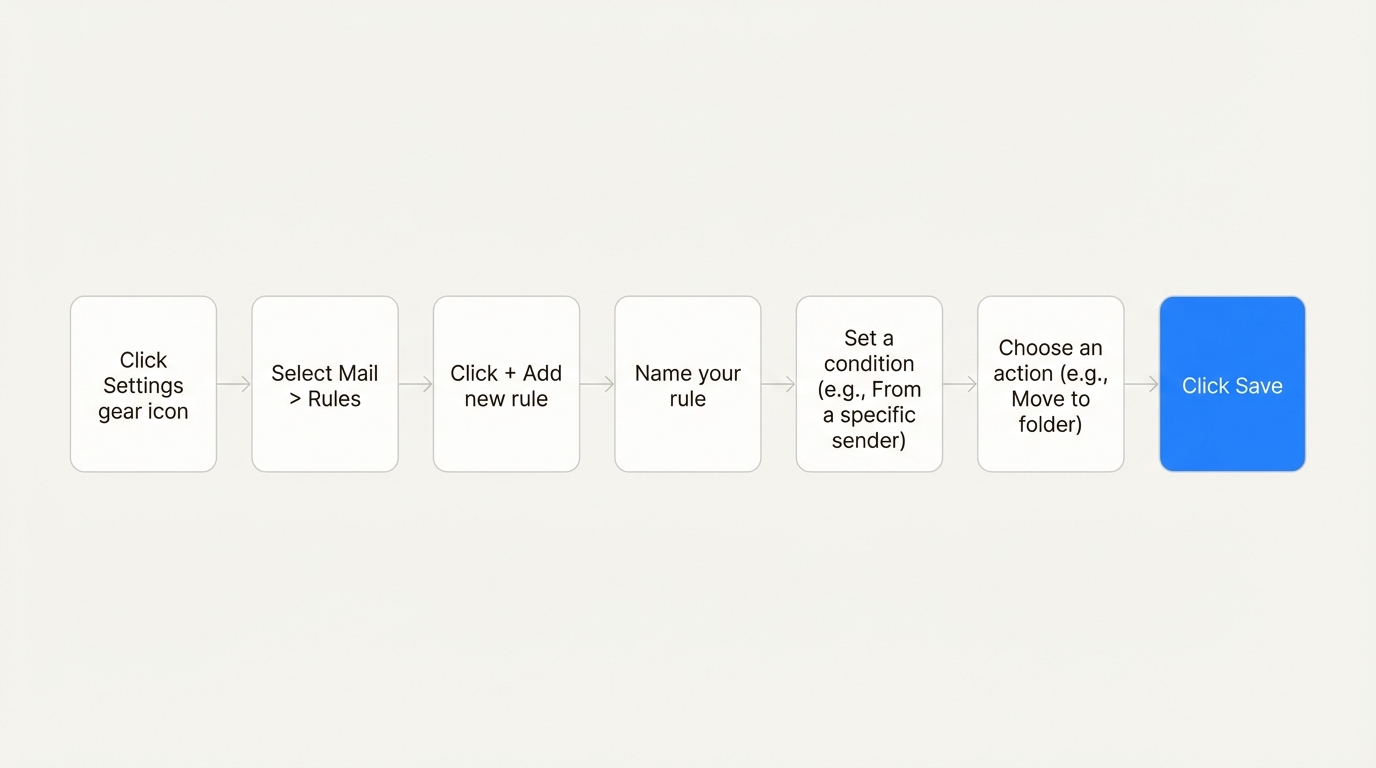
Click the Settings gear icon in the top right corner, then go to Mail > Rules.
Click + Add new rule.
Give your rule a name that makes sense to you.
Add a condition. This is the “if” part, like “From” a specific sender or “Subject includes” certain words.
Add an action. This is the “then” part, like “Move to” a folder or “Delete.”
If you have multiple rules, check the “Stop processing more rules” box to keep them from clashing.
Click Save.
One important limitation: the new Outlook does not support rules for third-party accounts you’ve connected, like Gmail or iCloud. For those, you’ll have to set up sorting rules directly with that email provider.
Classic Outlook for Windows
The classic desktop version has the most detailed options, accessible through its Rules Wizard. It’s also where you’ll have to think about the client-side vs. server-side distinction.
There are two main ways to start:
From a message: The fastest method. Right-click an email that’s a good example of what you want to automate, then select Rules > Create Rule. Outlook will pre-fill some of the conditions for you, like the sender’s name. This is what you want if you’re wondering how to create a rule from a selected email.
From a template: For more control, go to File > Manage Rules & Alerts > New Rule. This opens the Rules Wizard, which gives you templates for common tasks like “Move messages from someone to a folder.”
The Rules Wizard walks you through a few steps: choose a template, set your conditions (the “if”), pick your actions (the “then”), add any exceptions, name the rule, and turn it on.
A useful feature here is the “Run this rule now on messages already in the current folder” option. It’s good for cleaning up an existing folder right after you create a rule.
Outlook for Mac recently simplified its approach. To make rules more reliable, it now only supports server-side rules. Your automation will always work, even when the app is closed. The trade-off is that client-side actions like custom sounds are no longer available.
Here’s how to set one up:
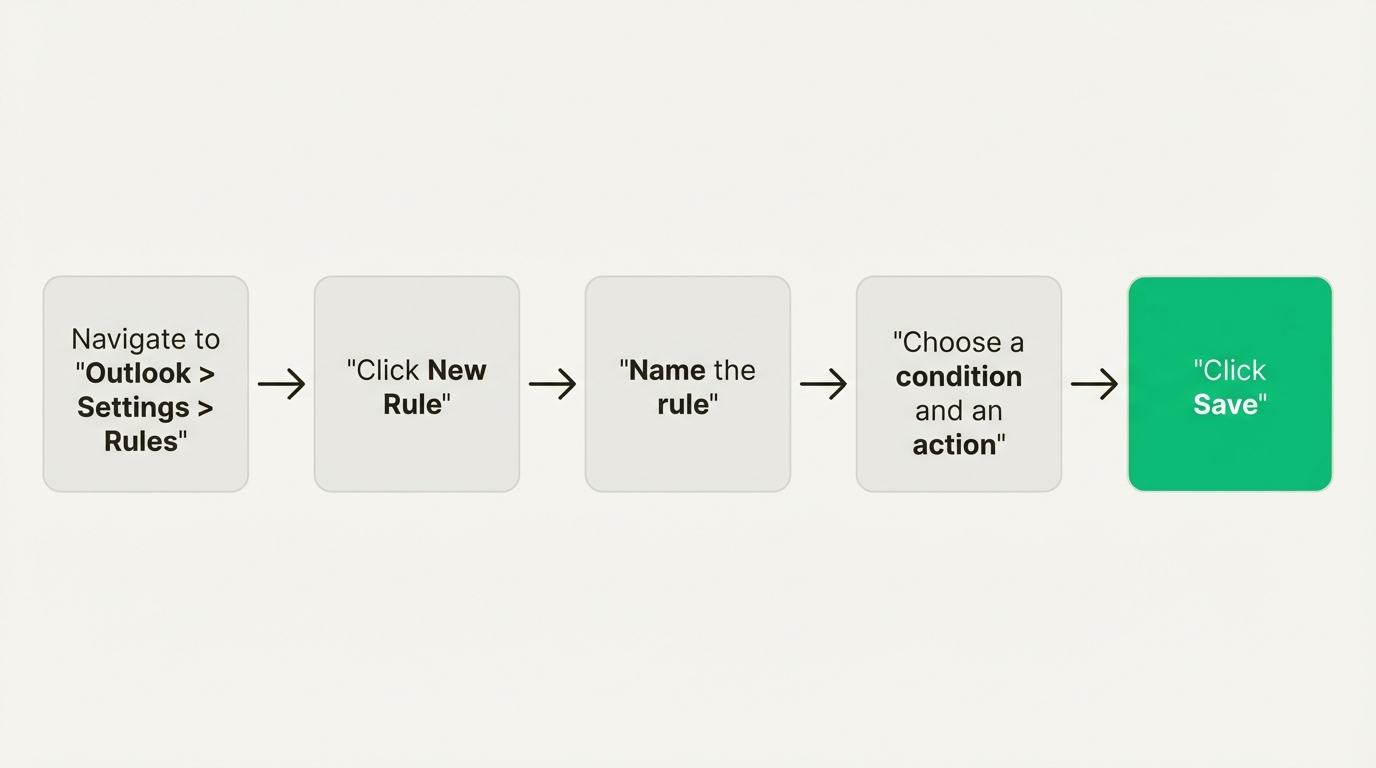
From the top menu bar, go to Outlook > Settings > Rules.
Click New Rule and give it a name.
Choose a condition (like “From”) and an action (like “Move to Folder”).
Use the “Stop processing more rules” option if you need to avoid conflicts.
Click Save.
Features and limitations of Outlook rules
Now that you know how to build rules, here’s where they shine and where they fall short, especially for teams.
Core capabilities
For managing your own personal inbox, Outlook rules are capable. They’re particularly good at a few things:
Sorting. You can automatically move messages based on the sender, keywords in the subject line, or whether you’re in the To or CC field. This is the quickest way to keep your main inbox focused on what needs your attention right now.
Prioritization. Set up a rule to flag any message from your manager or with the word “urgent” in the subject. Important messages float to the top; nothing gets missed.
Inbox cleaning. Tired of promotional emails and newsletters cluttering up your inbox? A rule can send them to a “Read Later” folder or delete them on arrival.
Custom alerts. In classic Outlook, you can set up desktop alerts or sounds for high-priority emails, so you get an immediate heads-up when something important lands.
Limitations for team collaboration
These features were designed for individual use. In a team setting, the limits show up fast.
They aren’t collaborative. Rules are tied to a single user’s account. You can’t create a rule to automatically assign a new customer question to the next available person on your support team. You can’t balance the workload for a shared inbox like sales@company.com. That work stays manual, which means duplicate replies or missed emails.
They’re email-only. Business communication isn’t just email anymore. Your team is probably juggling messages from SMS, WhatsApp, website live chat, and social media. Outlook rules only work on email, so other channels get managed in separate tools. Conversations get split; customer messages slip through.
They can be device-dependent. The client-side rule limitation is a problem for teams that need constant availability. A rule you built to notify you about an urgent lead won’t run after hours if your work computer is off. Real automation needs to be on all the time, not just when you’re at your desk.
Rule management gets messy. As your list of rules grows, they start to conflict or break. The bigger issue is the 256 KB storage cap. Power users hit the ceiling and are suddenly unable to create any more rules. People work around it by shortening rule names or cramming multiple conditions into one rule to save bytes.
These limits show that Outlook rules are built for individual productivity. For teams that need collaborative automation across multiple channels, a different tool is a better fit.
When to consider alternatives to Outlook rules
Outlook rules are a great starting point for taming your personal inbox. When workflows involve multiple people, though, the individual-focused model runs out of room. If your team needs shared ownership, clear accountability, and a single place for all customer conversations, a more capable rule system is worth looking at.
Missive is a collaborative email client built for teams. It connects your team’s shared addresses (support@, sales@, info@) alongside personal inboxes, and it handles email, SMS, WhatsApp, Instagram, Messenger, and live chat in one place. Missive’s rules can do everything Outlook rules do and more: assign conversations in a round-robin, add internal comments for context, apply shared tags, and run automations across every channel, not just email.
Three examples of what Missive rules can do that Outlook rules can’t:
Service level agreements: set up SLAs to maintain short response times across your whole team. Specify reminders and escalate to certain users if breached.
Escalate urgent emails using AI: have AI process the context of incoming client emails. If they’re urgent, escalate and assign to a pre-selected person.
Automatic follow-ups: trigger a sequence of follow-up emails based on an email you sent. Automatically stop following up once someone replies.
Here’s a deep dive into the difference between personal rules and organization rules:
FAQ
How do you create a new rule in Outlook?
In the new Outlook for Windows or Outlook.com, go to Settings > Mail > Rules > + Add new rule. Give the rule a name, pick a condition (like “From [sender]”), pick an action (like “Move to [folder]”), and save. In classic Outlook, go to File > Manage Rules & Alerts > New Rule to open the Rules Wizard. In Outlook for Mac, go to Outlook > Settings > Rules > New Rule.
How do I make certain emails go directly into a folder in Outlook?
Create a rule with a condition that matches the emails you want to sort (for example, “From: newsletter@example.com” or “Subject contains: Invoice”), then set the action to “Move to” and pick the folder. Check “Stop processing more rules” if you have other rules that might conflict. New messages matching the condition will land in the folder instead of your main inbox, and you can also run the rule on existing messages in classic Outlook via the “Run rules now” option.
How do you create a rule based on a selected email?
In classic Outlook for Windows, right-click the email and select Rules > Create Rule. Outlook pre-fills the conditions based on the selected message (sender, subject line, recipients), so you can confirm or tweak the details rather than building the rule from scratch. In the new Outlook and on Mac, the right-click option is more limited; you’ll usually need to open the full rule editor and enter conditions manually.
Can I set up Outlook rules to forward emails automatically?
Yes, but with caveats. You can create a rule with the action “Forward it to [email address]” to automatically forward matching messages. However, many organizations disable external auto-forwarding by default as a security measure against phishing and data exfiltration. If your rule silently stops working, check with your IT admin first.
Why aren’t my Outlook rules running?
The three most common reasons: (1) the rule is client-side and Outlook is closed, so it won’t fire until you open the app; (2) you’ve hit the 256 KB rules storage limit, and new rules are being silently ignored; (3) rules earlier in the list with “Stop processing more rules” are intercepting the message first. Microsoft has a broken rule troubleshooter for the first issue, and you can free up space by deleting unused rules or consolidating them.
Do Outlook rules work on mobile?
Rules created on desktop or web will run on any device as long as they’re server-side. You can’t create or edit rules from the Outlook mobile app directly; you’d need to open the web version in a mobile browser to make changes.
What’s the difference between Outlook rules and Missive rules?
Outlook rules are per-user and email-only. Missive rules are team-level and cross-channel. A Missive rule can assign an incoming conversation to a specific teammate, apply tags visible to everyone, add internal chat messages for context, and run across email, SMS, WhatsApp, Instagram, and live chat. Outlook rules can’t assign, can’t add team notes, and don’t know about anything outside of email.
Missive is a collaborative email client built for teams that have outgrown personal rules. Connect your team’s shared addresses, automate assignments with AI-powered rules, and handle every customer channel from one place. Try Missive free.



.png)

.png)
.png)