> For the complete documentation index, see [llms.txt](https://missiveapp.com/docs/llms.txt). Markdown versions of documentation pages are available by appending `.md` to page URLs; this page is available as [Markdown](https://missiveapp.com/docs/advanced-features/guest-access/access-and-preferences.md).
# Access & preferences
Configure guest permissions and access levels.
Managing guest access in Missive gives you control over who can join conversations and how external collaborators interact with your team.
You can manage guests and their permissions primarily through the **Settings > Guests** menu.
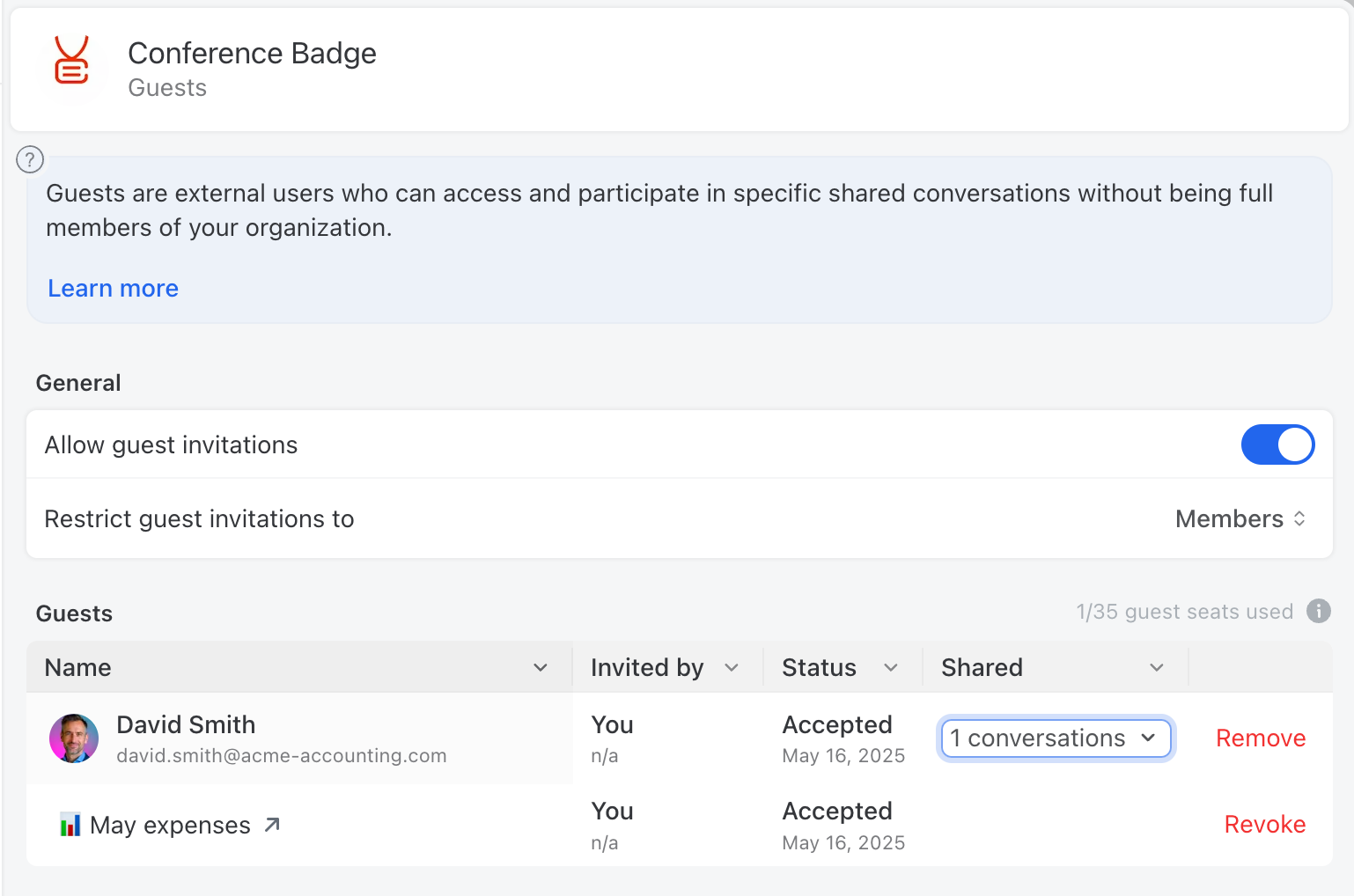
### Viewing and revoking guest access
**Open the guests settings:**
* View all invited guests.
* See the number of conversations they have access to and who invited them.
* Revoke a guest's access entirely or from specific conversations.
### Configuring organization guest permissions
These settings let you define how tightly guest invitations should be controlled based on your team's workflows and security needs.
**Open the guests settings:**
* Enable or disable guest access across the entire organization.
* Control who can invite guests:
* Only admins and organization owners
* All members
### Configuring conversation-level permissions
Even when guest access is allowed at the organization level, individual conversations can still opt out. This is useful for keeping certain conversations internal, even if your team regularly collaborates with external partners elsewhere in Missive.
**To disable guest access for a specific conversation:**
1. Open the conversation.
2. Click the **Share Access** icon or user avatars at the top-left of the conversation.
3. Click **Invite guests**.
4. Toggle off **Allow guests**.
---
# Agent Instructions
This documentation is published with GitBook. GitBook is the documentation platform designed so that both humans and AI agents can read, navigate, and reason over technical content effectively. Learn more at gitbook.com.
## Querying This Documentation
If you need additional information that is not directly available in this page, you can query the documentation by asking a question.
Perform an HTTP GET request on the following URL with the `ask` and `goal` query parameters:
```
GET https://missiveapp.com/docs/advanced-features/guest-access/access-and-preferences.md?ask=&goal=
```
`ask` is the immediate question: it should be specific, self-contained, and written in natural language.
`goal` is what the user is ultimately trying to achieve, the reason they need the answer. Sharing it helps GitBook give you a better, more relevant answer. A goal is most helpful when it describes the outcome the user wants rather than restating the question. For example, with `ask=how do I create an API token`, a goal like `automate deployments from our CI pipeline` lets GitBook tailor the answer to that use case.
The response will contain a direct answer to the question and relevant excerpts and sources from the documentation.
Use this mechanism when the answer is not explicitly present in the current page, you need clarification or additional context, or you want to retrieve related documentation sections.