> For the complete documentation index, see [llms.txt](https://missiveapp.com/docs/llms.txt). Markdown versions of documentation pages are available by appending `.md` to page URLs; this page is available as [Markdown](https://missiveapp.com/docs/advanced-features/rules/examples/complex-rules.md).
# Complex rules
Advanced rule examples: multiple conditions, chained actions.
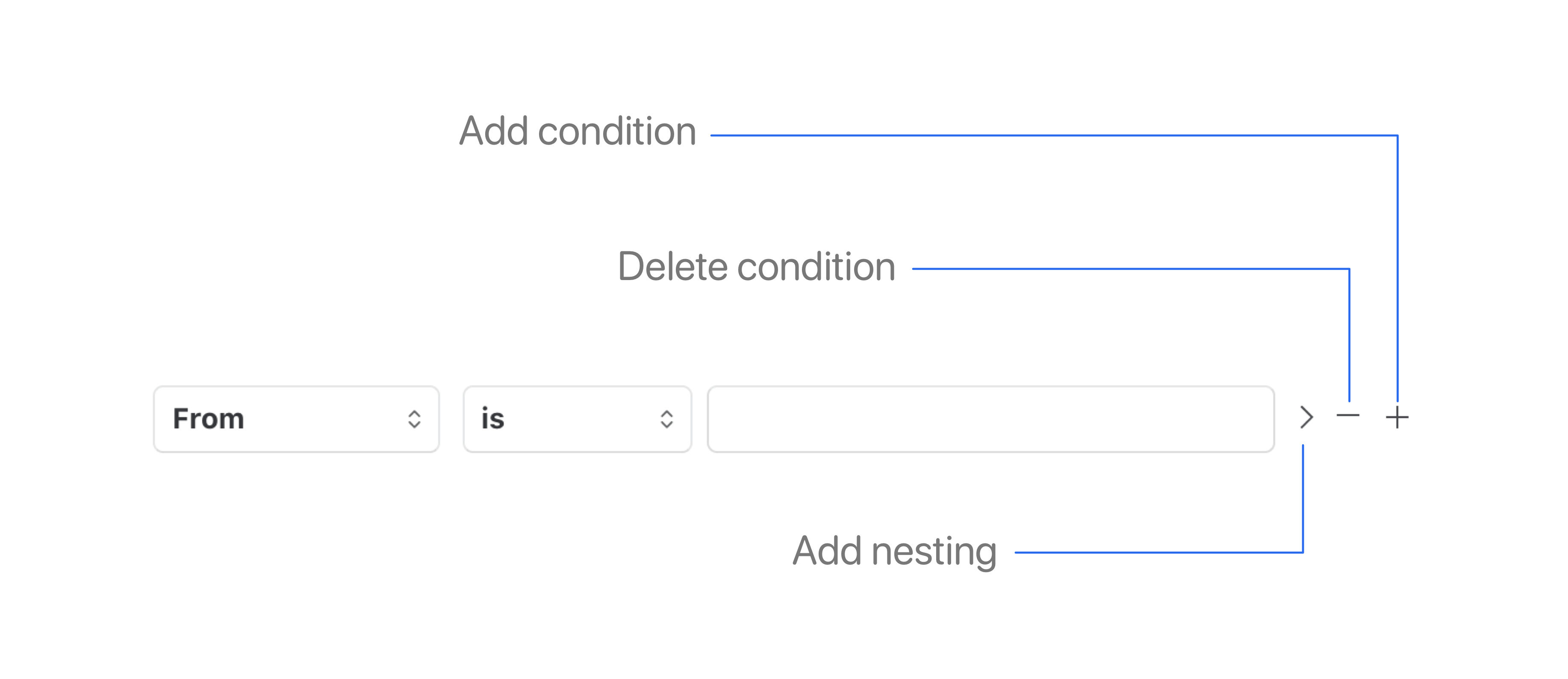
These examples show how to combine multiple conditions using nested groups. Use the **>** button to create subgroups with different match logic (all vs any).
## Training new employees
**Rule type:** Incoming message
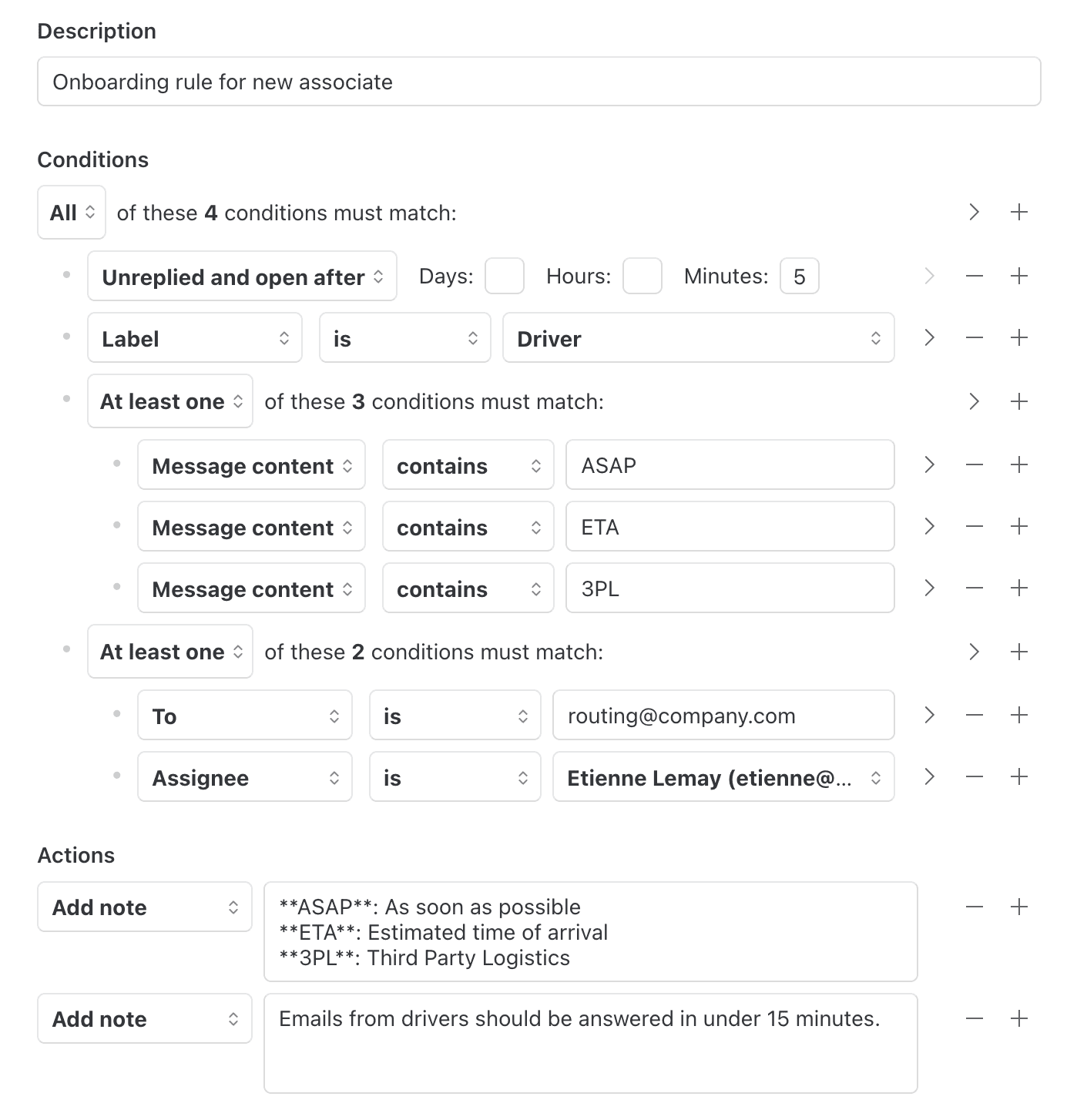
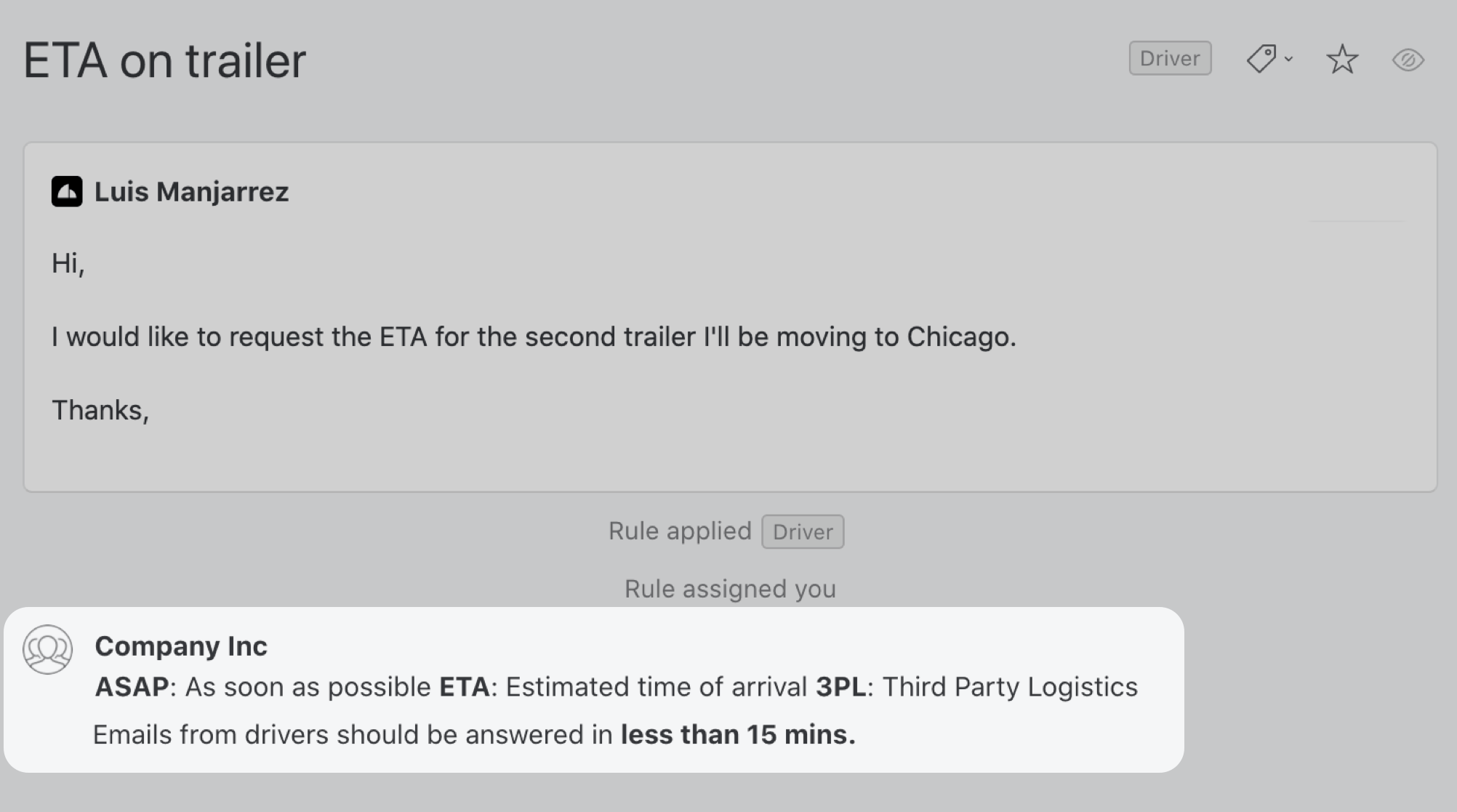
A logistics company wants to help new routing staff learn company acronyms and response time requirements.
**Conditions (all must match):**
* Message sent to OR assignee is the new employee
* Message contains at least one abbreviation (ETA, POD, BOL, etc.)
* Label "Driver" is present
* Message has been in inbox for 5+ minutes
**Actions:**
* Add note with common acronym definitions
* Add note reminding of 15-minute SLA
## Track invoices and payment reminders
**Rule type:** Outgoing message
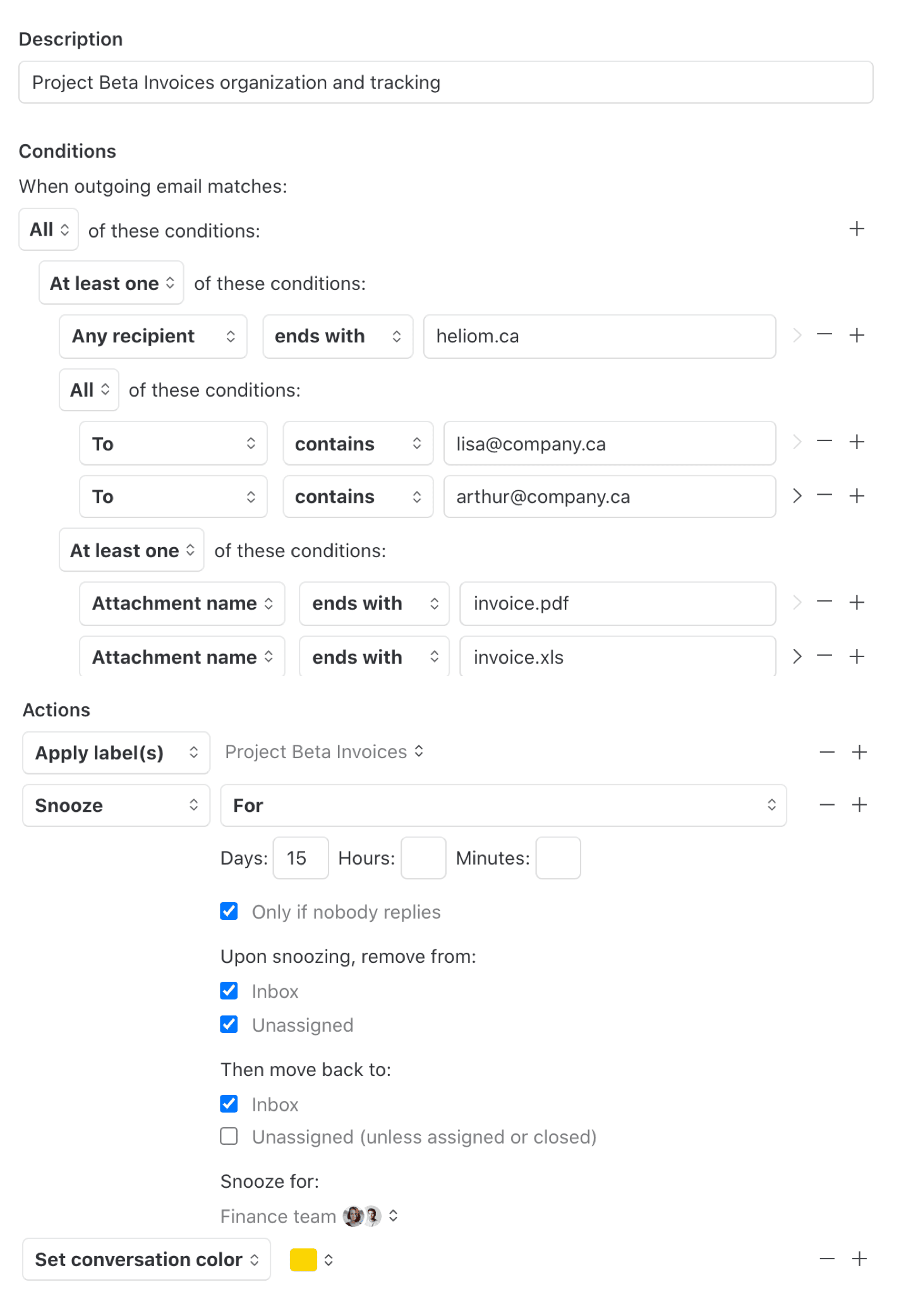
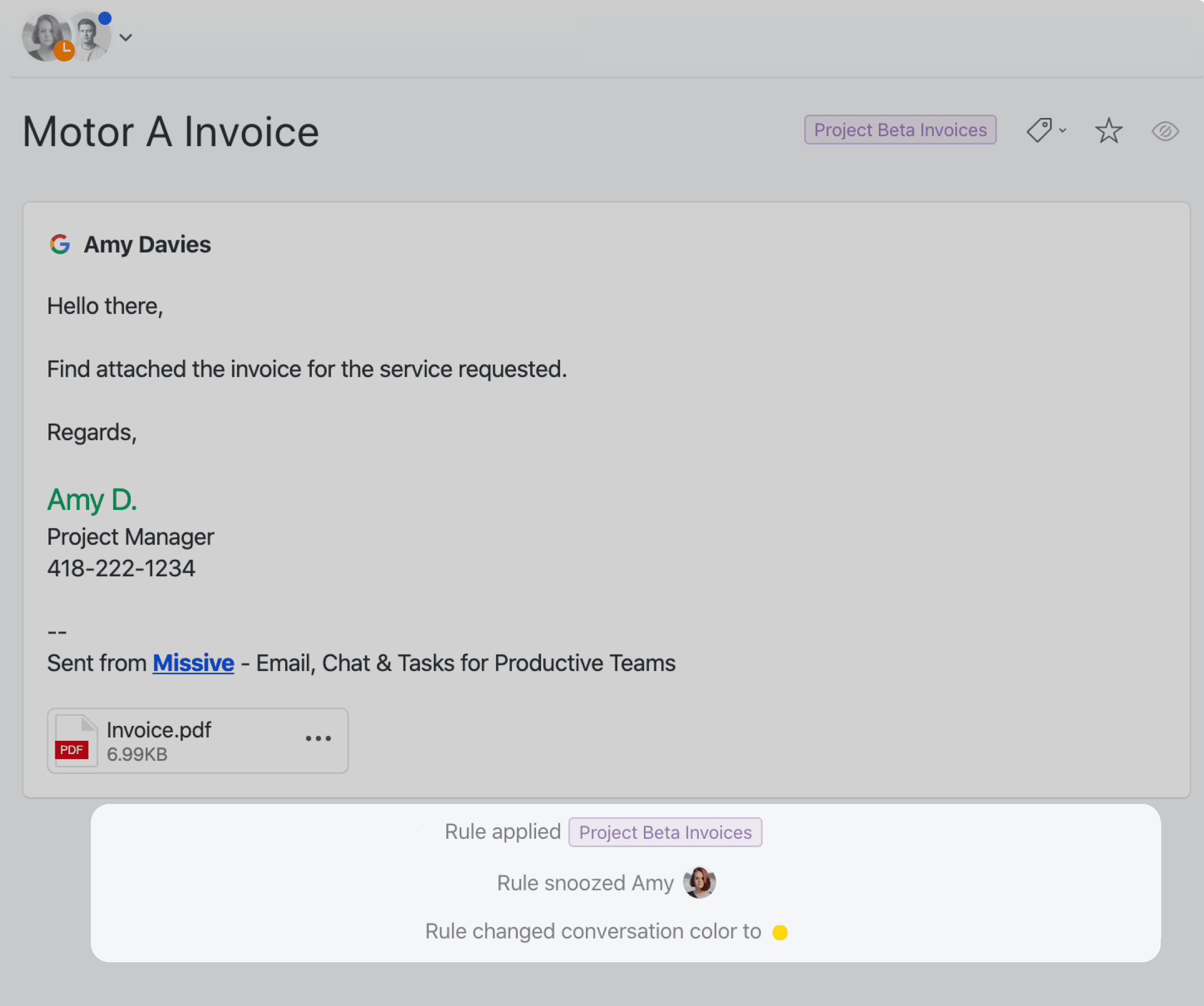
A project manager sends invoices to two customers and needs to track payments.
**Conditions (any must match):**
* Recipient ends with @acme.com
* Recipients include both AND
* Attachment name ends with .pdf OR .xls
**Actions:**
* Add label "Project Beta Invoices"
* Set conversation color to yellow
* Snooze for 15 days (payment reminder)
## Quick to-do workflow
**Rule type:** User actions → New comment
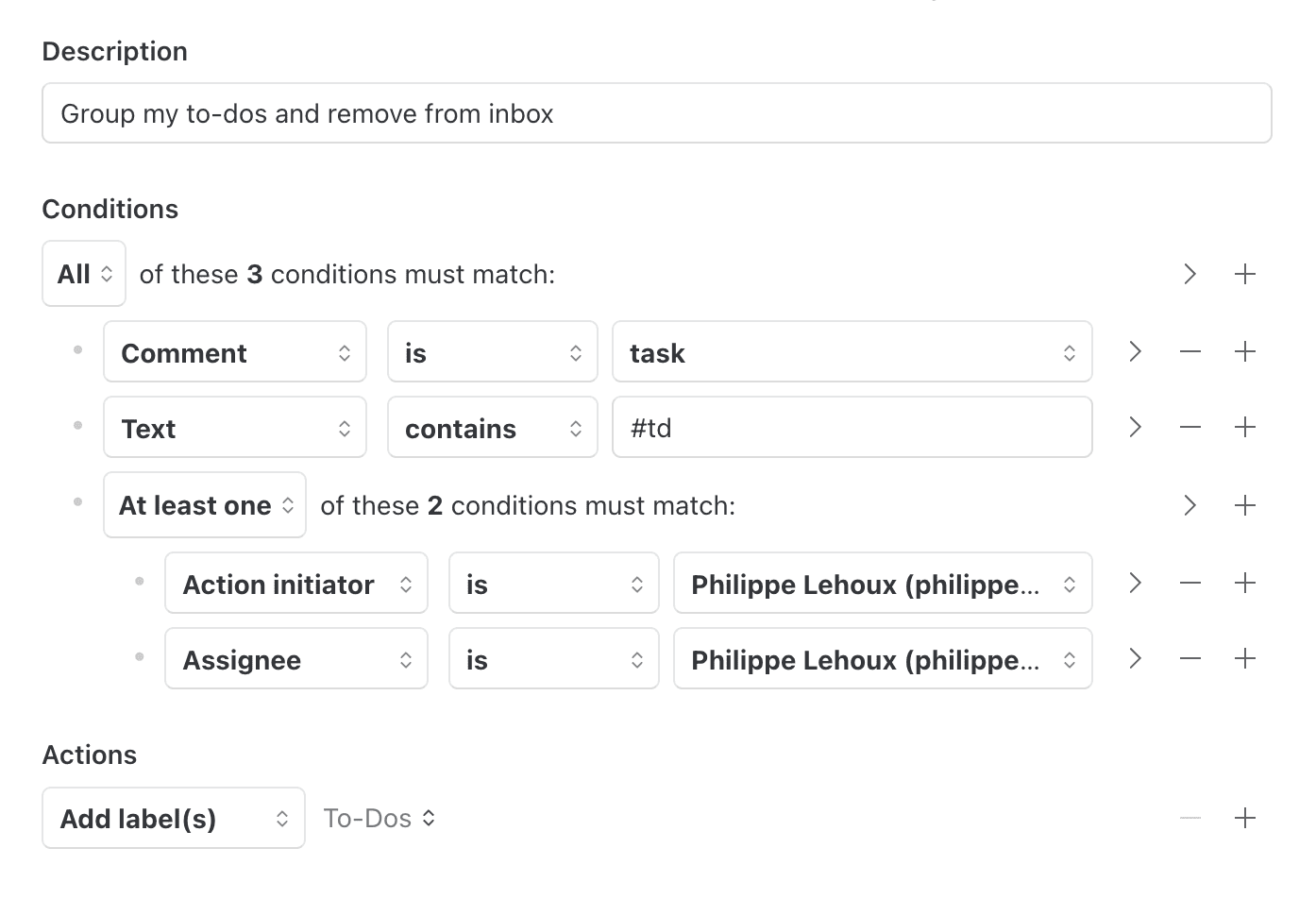
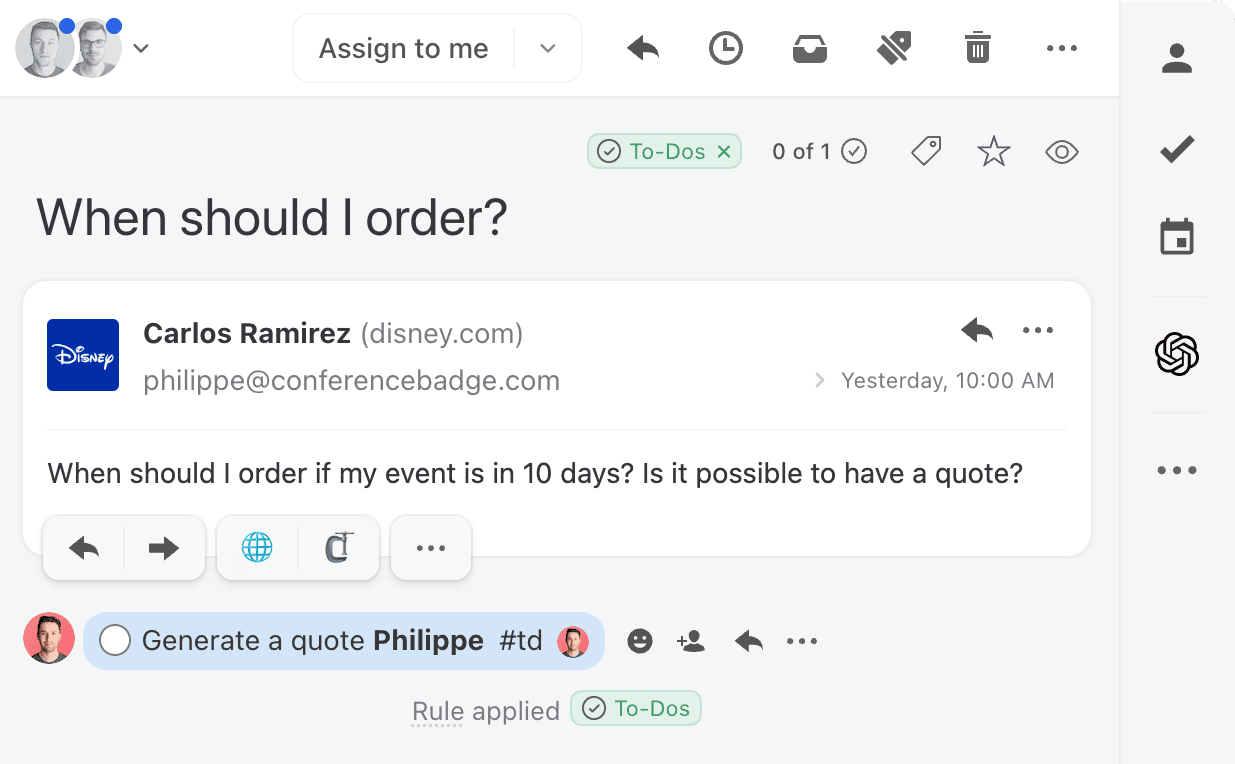
A salesperson uses a shortcode (#td) to quickly move conversations to a to-do list.
**Conditions (all must match):**
* Comment is a task
* Comment text ends with "#td"
* User is assigned OR user initiated the action
**Actions:**
* Add label "To-do"
* Archive from inbox
---
# Agent Instructions
This documentation is published with GitBook. GitBook is the documentation platform designed so that both humans and AI agents can read, navigate, and reason over technical content effectively. Learn more at gitbook.com.
## Querying This Documentation
If you need additional information that is not directly available in this page, you can query the documentation by asking a question.
Perform an HTTP GET request on the following URL with the `ask` and `goal` query parameters:
```
GET https://missiveapp.com/docs/advanced-features/rules/examples/complex-rules.md?ask=&goal=
```
`ask` is the immediate question: it should be specific, self-contained, and written in natural language.
`goal` is what the user is ultimately trying to achieve, the reason they need the answer. Sharing it helps GitBook give you a better, more relevant answer. A goal is most helpful when it describes the outcome the user wants rather than restating the question. For example, with `ask=how do I create an API token`, a goal like `automate deployments from our CI pipeline` lets GitBook tailor the answer to that use case.
The response will contain a direct answer to the question and relevant excerpts and sources from the documentation.
Use this mechanism when the answer is not explicitly present in the current page, you need clarification or additional context, or you want to retrieve related documentation sections.