If you're evaluating Superhuman, the first thing worth saying out loud: it's good at what it does. Keyboard-driven speed, AI-assisted writing, premium polish. For one person processing a dense personal inbox, $30/user/month often pays for itself.
The trouble is what happens when "one person processing email" turns into "a team handling email together." That's where Superhuman runs out of road, and where teams in our customer base end up trialing alternatives. This piece is for that situation: you've used or are considering Superhuman, your work is increasingly collaborative, and you want to know what changes if you switch.
We'll go deep on Missive specifically since it's the alternative we know best, and the option teams in our customer base most often land on after evaluating Superhuman.

Superhuman vs. Missive at a glance
Superhuman is a premium email client built on top of Gmail and Microsoft 365. It markets itself as the fastest email experience ever made, with 100+ keyboard shortcuts, AI-assisted writing in your voice, and a deliberately minimal interface. It was designed for one person processing their own inbox at speed.
Missive is a full email client built around team collaboration. It also handles personal email cleanly, but the design center is multi-person workflows: shared inboxes, threaded internal chat inside conversations, multi-assignee tasks, and rules for routing work across teammates. It works on every email provider (Gmail, Microsoft 365, IMAP) and adds SMS, WhatsApp, live chat, and social channels into the same workspace.
The architectural distinction shows up on day one: Superhuman optimizes individual inbox velocity. Missive treats email as something teams do together.
Channels: email-only vs. multichannel
Superhuman supports Gmail and Microsoft 365, and only email. Everything else (SMS, WhatsApp, live chat, social DMs) lives in another tool.
Missive collaborates across:
- All email providers, Gmail, Google Workspace, Microsoft 365, Outlook, Yahoo, IMAP/SMTP
- Live chat on your website
- SMS via Twilio, SignalWire, Dialpad, or Quo
- Social: Messenger, Instagram
- Custom channels via the API
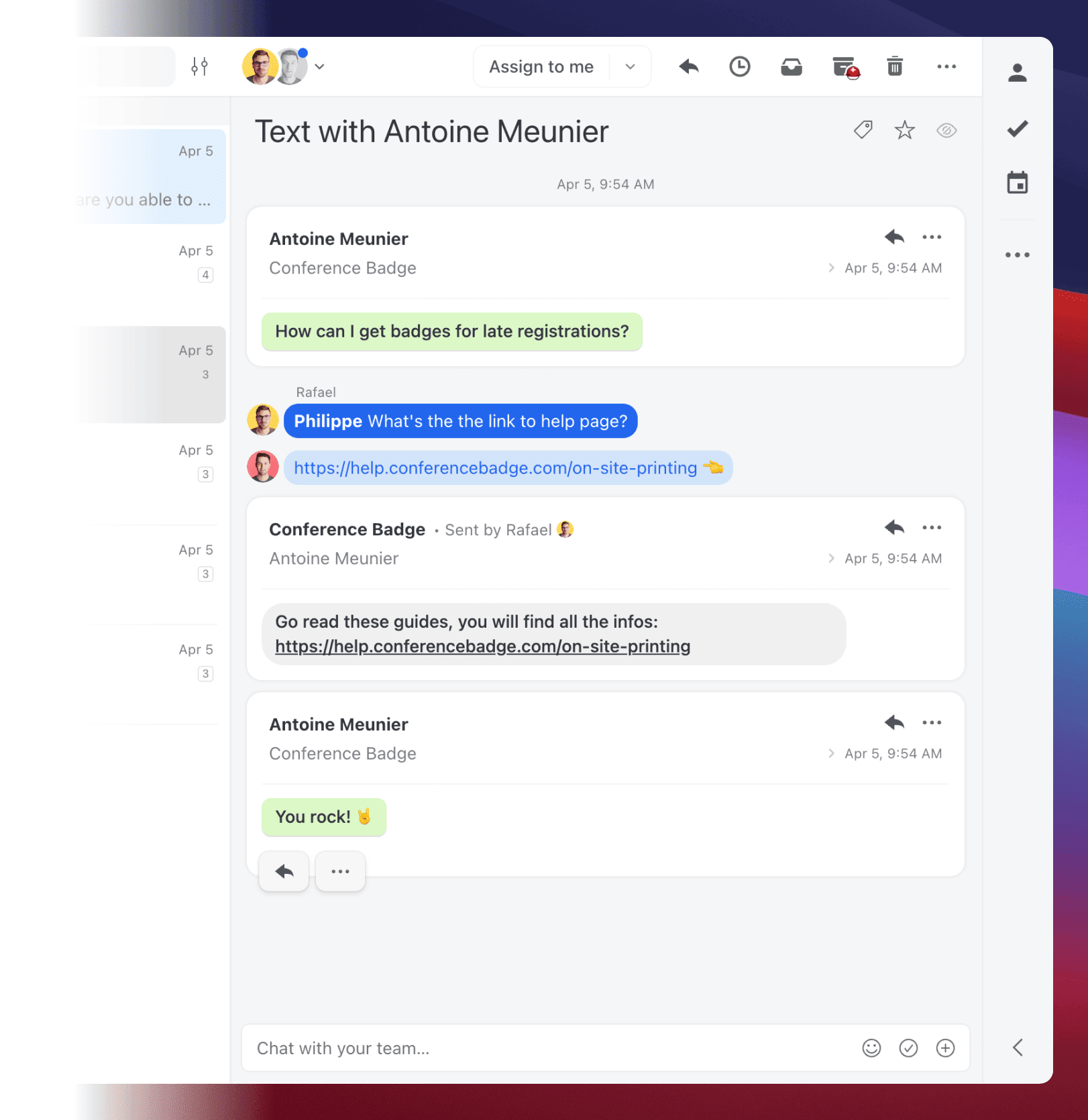
If a customer emails you Monday and WhatsApps you Wednesday, both threads are in the same workspace, and your team can pick up the second message with full context from the first.
Multiple email accounts and shared inboxes
Superhuman's account model is straightforward but limited: one user, their own inbox, with Split Inbox views to slice that inbox into categories. There's no concept of multiple shared inboxes a team co-manages. Superhuman added Shared Conversations and Team Comments over the years, but those are visibility layers on top of personal inboxes, not real shared mailboxes.
In Missive, a single account can hold any number of personal accounts (your own work email, your team email, your support@ alias) and any number of shared inboxes (help@, sales@, info@). All of them flow into one unified view, with separate inboxes available when you need to focus.
For teams running 5-50 email accounts across departments or brands, this is the difference between "I have to switch profiles to check the right inbox" and "everything's in one place." Aliases let you reply as different addresses or delegate sending rights to teammates without losing visibility.
Speed and keyboard shortcuts
Superhuman's biggest selling point is raw speed: 100+ keyboard shortcuts, fast rendering, command palette for almost every action. After a few weeks of muscle memory, power users genuinely process email faster than they would in Gmail.
Missive ships keyboard shortcuts too, with a fully customizable shortcut system, but it doesn't try to be the fastest pure email client on the market. The trade-off is intentional: Missive's design has to work for keyboard power-users and for teammates who want to use a mouse, multi-swipe on mobile, or work from the web in Linux.
The honest framing: if your bottleneck is one person clearing 200+ daily emails as fast as humanly possible, Superhuman is purpose-built for that. If your bottleneck is your team's collective response time on shared inboxes, individual keyboard speed isn't the lever that matters.
Available everywhere
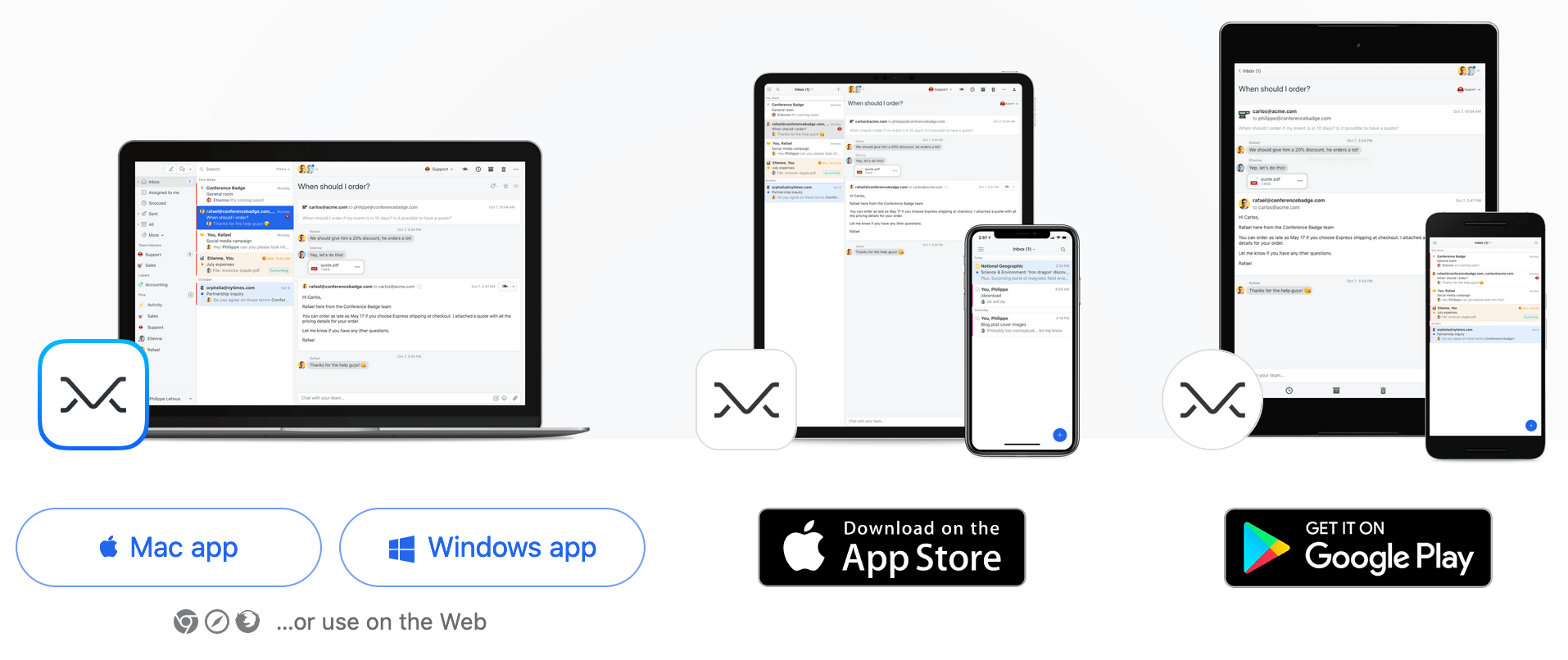
Both apps run on Mac, Windows, iOS, and Android. Missive also ships a full web app that runs in any modern browser, including on Linux. Feature parity across platforms is a Missive design goal: the mobile app does what the desktop app does, including assignment, internal chat, rules-driven workflows, and multi-swipe actions.
Superhuman's mobile experience is solid for individual email processing, but the keyboard-first design means the desktop app is where the speed gains actually compound.
Pricing
The pricing question is the one most people skip to.
Missive pricing
Missive offers three paid tiers, all annual (monthly billing is roughly 20% higher). Every new team starts with a 30-day free trial that includes Productive features:
- Starter, $14/user/month: up to 5 users, unlimited history, shared inboxes.
- Productive, $24/user/month: up to 50 users, integrations, rules, API access, AI Assistant.
- Business, $36/user/month: unlimited users, advanced analytics, SAML SSO, IP restriction.
30-day free trial with Productive features, up to 25 users. No credit card required.
Superhuman pricing
Superhuman has three tiers, with annual billing offering roughly 17% off:
- Starter, $30/user/month (or $300/year, ~$25/month annual): keyboard shortcuts, Superhuman AI, calendar, scheduling, group productivity coaching.
- Business, $40/user/month (or $396/year, ~$33/month annual): adds Auto Drafts, Ask AI, Custom Auto Labels, HubSpot and Salesforce integration, Recent Opens Feed.
- Enterprise: custom pricing for SSO, advanced security, and dedicated support.
No free plan for Superhuman Mail. Trial terms are not published on their pricing page, and a guided onboarding call is required before your account is activated. The separate Superhuman Suite (the Grammarly and Coda bundle) does have a $0 tier; the Mail product does not.
The math: a 10-person team on Missive Productive runs $2,880/year. The same team on Superhuman Starter (annual) is $3,000, or $3,960 on Business. The per-seat gap is modest at small headcount but widens at scale: at 50 users, Missive Productive is $14,400/year while Superhuman Business is $19,800. Add Superhuman's monthly-billing premium (no annual discount) and the difference widens further.
Rules and automation
Superhuman's automation surface is shallow by design. Split Inbox categorizes incoming mail into prioritized buckets, and that's the main automation primitive. There's no rules engine for outgoing email, no user-action-based rules, no team-level automation that routes work across people.
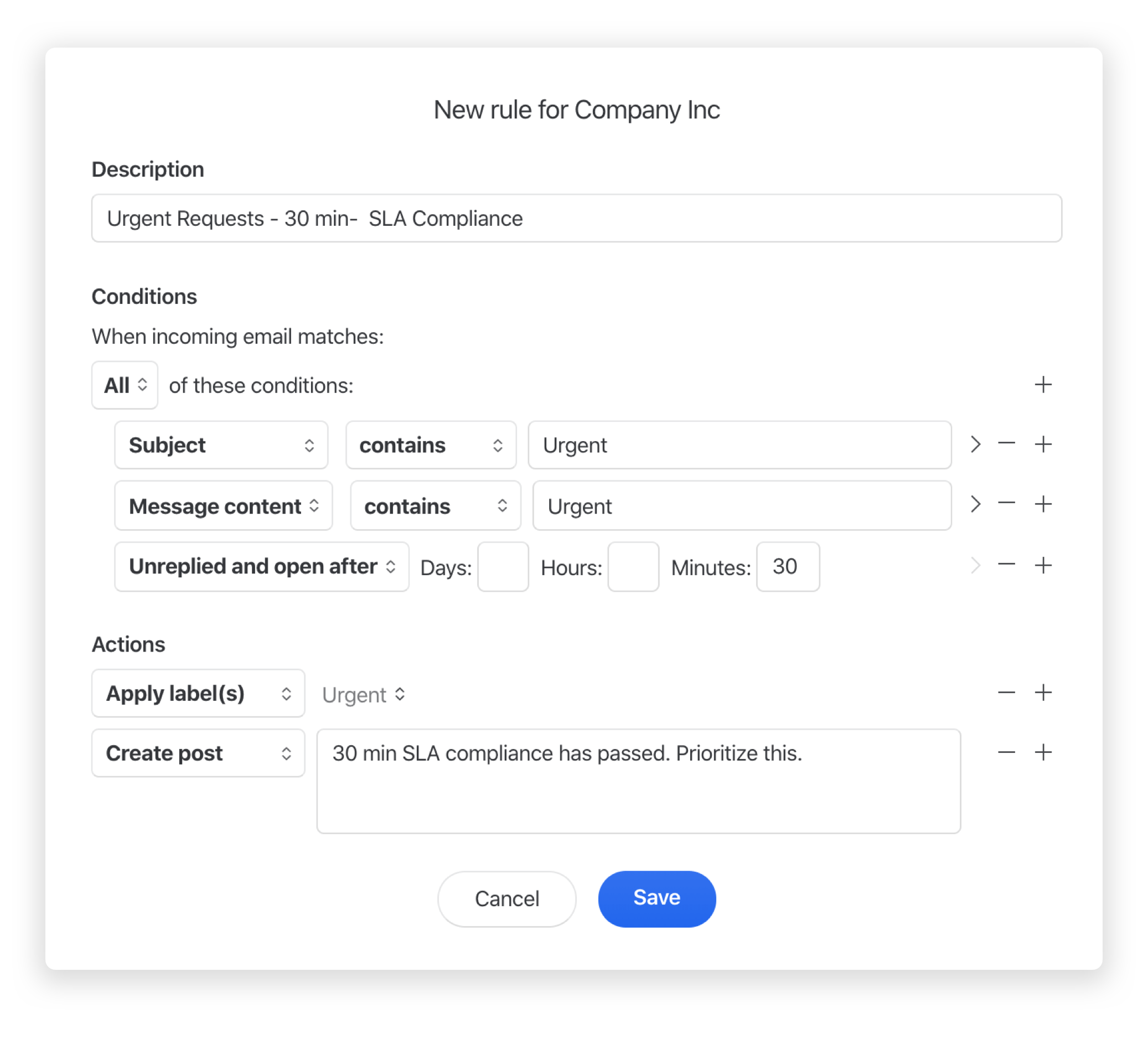
Missive supports up to 1,000 personal rules plus 1,000 organization rules per organization on the Productive and Business plans. Rules can fire on incoming messages, outgoing messages, or user actions (new comment, label applied, conversation assigned, conversation closed):
- Auto-label conversations by content, sender, or thread state
- Route emails to teammates based on the email content
- Run an SLA program with time-based escalation
- Snooze after-hours emails until business hours
- Notify a Slack channel when a labeled conversation arrives
AI features
Both products ship AI, but with different design centers.
Superhuman's AI is built around individual inbox processing: write replies in your tone, Auto Drafts on Business tier, Ask AI for cross-thread search, Auto Summarize for long threads, Auto Labels, and reminders for emails you might have forgotten. The features are well-built and tightly integrated with Superhuman's keyboard shortcuts.
Missive's AI covers the same individual workflows (drafting, summarizing, tone adjustment, translation) and goes further with AI rules, automation that uses plain-language prompts to triage, label, route, and reply. An example: detect whether an inbound email is a buying or selling inquiry, label it accordingly, assign the right teammate, create follow-up tasks with due dates, and post a summary in chat.

Missive AI is included on the Productive and Business plans. Superhuman's full AI feature set requires the Business tier ($40/user/month). For team workflows that involve routing, assignment, or multi-step processing, Missive's AI rules cover ground Superhuman's individual-focused AI doesn't.
Designed for teams
This is the section that drives most switches. Superhuman was built for individual users, and the team features it added (Shared Conversations, Team Comments, Read Statuses, Team Reply Indicators) are visibility layers that tell you what your teammates are doing, but they don't restructure email around team workflows.
Missive is built around the unit of work most teams actually have: a shared conversation that needs an assignee, an internal discussion, sometimes a few tasks, and a clear "who's responsible" answer. Internal chat lives inside the conversation thread, so the discussion about an email and the email itself stay glued together.
Concretely: if a partner emails about renegotiating contract terms and you need to loop in legal and finance before replying, you can chat about it inside the email thread, assign tasks to specific people for the work the renegotiation triggers, and reply once the team has aligned, all without leaving the conversation.
Read more about the internal chat feature and how it changes shared-inbox workflows.
Canned responses and templates
Both apps support templates. Superhuman calls them Snippets and supports sharing across the team. Missive calls them canned responses, also team-shareable, with a few details that compound:
- Full-text preview before inserting, so you don't have to memorize teammate-authored responses
- Fuzzy search by title, subject, or content (typing "ho bet pers" finds "How to be a better person?")
- Variables for inserting customer-specific data inline
- Label-based organization for finding the right response in a large library
Calendar
Superhuman's calendar is essentially a scheduling widget: quick add events, share availability inside an email thread, integrations with Zoom, Meet, and Teams. Most calendar fields (location, full event details) aren't surfaced.
Missive ships a full calendar that supports Google Calendar and Microsoft 365 accounts, with team-shareable events and entire calendar accounts. You can schedule meetings, get reminders for upcoming events and planned tasks, and share availability without bouncing between apps. The rebuilt calendar also handles team scheduling: with Meet with, type a teammate, team, or contact into the sidebar and their availability appears over your own, create the event and they’re added as guests, and extra time zone columns show up automatically when teammates are in different zones. Focus time (on Google Workspace calendars) and custom recurrence are built in too.

Integrations
Superhuman ships integrations with HubSpot and Salesforce on the Business tier, plus Zoom, Meet, and Teams for calendar and meetings. The integration surface is intentionally narrow.
Missive offers native integrations with Salesforce, HubSpot, Pipedrive, Asana, Trello, Aircall, Dropbox, Shopify, and many more. Native here means seeing CRM records, deals, contacts, and tasks alongside email, and creating them from inside Missive, not a Zapier bridge.
You can also build custom integrations using the JavaScript API for systems that aren't on the integration list. Custom integrations work on desktop, mobile, and web.

What teams choosing between Superhuman and Missive tell us
The teams in our customer base who evaluated Superhuman alongside Missive consistently land in the same place: Superhuman is great at what it does, but it does the wrong job for teams.
The collaboration gap was the dealbreaker. Kason at i-SOLIDS, a 3D printing manufacturer, ran month-long trials of Superhuman, Spark, and Missive after his sales team grew past three people. He went into the evaluation with Superhuman as the favorite. "Superhuman was approaching my personal problem," he told us, but he cut it from the team trial: "I immediately knew its collaboration wasn't good enough." His specific concern was that Superhuman doesn't support consolidated inboxes or true shared email; the workarounds turn shared messages back into regular emails, defeating the point.
Multi-account workflows didn't fit either. Freedom at 22 Impact, a creative management agency running 10-11 email accounts across teams, tried Superhuman during a search for collaborative inbox tools and didn't like it. UI and multi-account handling fell short of what their existing setup was already doing. They moved to Missive specifically because it handled the "many shared accounts in one workspace" use case Superhuman doesn't address.
Superhuman set the bar that surfaced what teams actually need. Sunny at Cedar Consulting Group found Missive while researching tools like Superhuman. The firm was on Outlook and needed assignment and tagging, capabilities Superhuman doesn't ship at all.
Individual speed isn't the same as team scale. Norm at Wonoak, a real estate consulting firm in Los Angeles, was a Superhuman user before switching: "I used Superhuman and I was trying to fight back the inbox thing." It worked while he was a solopreneur. Once the team grew and inquiries started coming through email, SMS, and phone for the same issue, Superhuman couldn't bridge those channels or distribute work across his team.
The pattern: Superhuman keeps winning when one person is fighting their own inbox. The moment that inbox becomes shared territory, the same teams who liked it for personal use start looking for something else.
Is Missive the right Superhuman alternative for you?
Quick gut check:
- If you process 200+ personal emails a day and inbox speed is your bottleneck: Superhuman is purpose-built for that. Missive isn't trying to win that race.
- If you run a shared inbox or coordinate email with teammates: Missive is built for that workflow; Superhuman's team features are visibility layers, not shared inbox plumbing.
- If your team handles email plus SMS, WhatsApp, social, or live chat: Missive consolidates these in one workspace. Superhuman is email-only.
- If pricing matters and your team is more than ~3 people: the per-seat math diverges fast as headcount grows.
- If anyone on the team isn't going to live in keyboard shortcuts: Missive is keyboard-friendly but doesn't require it. Superhuman's design assumes shortcuts.
Try Missive for free. 30-day trial with Productive features, no credit card required.
Frequently asked questions
What is Superhuman?
Superhuman is a premium email client built on top of Gmail and Outlook, focused on speed through 100+ keyboard shortcuts, AI-assisted writing, and a clean interface. It markets itself as "the fastest email experience ever made" and is popular among founders, executives, and salespeople who value individual inbox processing speed.
What's the main difference between Superhuman and Missive?
Superhuman is built for one person processing their own inbox faster. Missive is built for multiple people handling shared inboxes together. Superhuman's design center is keyboard-driven speed and AI-assisted individual workflows; Missive's is team collaboration with shared inboxes, threaded internal chat, and assignment.
If your job is "process my own email faster," Superhuman is built for that. If it's "answer email together with my team," Missive maps to the actual workflow.
Is Missive cheaper than Superhuman?
Yes, in every direct comparison. Superhuman's plans run from $30/user/month (Starter) to $40/user/month (Business) on monthly billing, or $25 and $33/month with annual billing. Missive's plans run from $14/user/month (Starter) to $36/user/month (Business). At the entry tier, Missive Starter is a little over half the price of Superhuman Starter.
The structural difference is how much room you get to decide. Missive gives you 30 days with Productive features, up to 25 people, and no credit card. Superhuman Mail has no free tier, and its trial requires a guided onboarding call before your account is activated.
Does Superhuman work for teams?
Partially. Superhuman added team features over time (Shared Conversations, Team Comments, Share Availability) and is used by sales teams who value individual speed across the team. But there's no shared-inbox concept, no assignment, no rules-based routing, and no multichannel support. Each user has their own optimized inbox; the "team" features are visibility layers on top of that.
For real team workflows where multiple people share an inbox like support@ or sales@, Missive's design (Team Inboxes, assignment flows, threaded internal chat inside conversations) fits the job that Superhuman's team features don't address.
Does Missive have AI features like Superhuman?
Yes. Missive includes AI for drafting replies in your tone, summarizing long threads, and powering AI rules that triage and route messages using plain-language prompts. Superhuman's AI is more focused on individual inbox processing: Auto Drafts (Business plan), Ask AI for cross-thread search, Auto Summarize, and AI writing in your voice.
Superhuman's AI is deeper for personal-inbox workflows. Missive's AI is broader, with first-class integration into team workflows.
What does Superhuman have that Missive doesn't?
Superhuman invests heavily in individual-user polish, especially keyboard-driven speed. For a single power user processing 200+ emails a day, those investments add up.
- Comprehensive keyboard shortcuts. 100+ commands accessible without a mouse, refined over years. Missive has shortcuts but not at the same depth.
- 1-on-1 onboarding training. Every Superhuman subscriber gets a 30-minute video call with a Superhuman expert. Included in the price.
- Read receipts and Recent Opens Feed. Built-in tracking of when recipients open emails. Missive doesn't ship native read receipts.
- Premium polish and design. Superhuman invests heavily in interface design and animation; the experience feels deliberately premium.
Why do teams switch from Superhuman to Missive?
The pattern is teams realizing they paid Superhuman pricing for what's still a personal email client. As the team grows, the gaps in shared-inbox workflows become harder to ignore.
- No real shared inbox. Superhuman doesn't have a concept of multiple people working on the same inbox with assignment and collision detection. Missive does.
- Pricing for teams. $30-$40/user/month at scale gets expensive. A 20-person team is paying $7,200-$9,600/year for individual email speed; the same team on Missive Productive ($24/user/mo) pays $5,760.
- Multichannel. Email, SMS, WhatsApp, live chat, social, all unified in Missive. Superhuman is email-only.
- No mouse, no inbox. Superhuman's keyboard-first design doesn't fit everyone. Missive works equally well with mouse-and-keyboard or full keyboard navigation.
Does Superhuman have a free plan?
No. Superhuman Mail is paid, with a trial and a required onboarding call before activation. Missive doesn’t have a free plan either. Every new team gets a 30-day trial with Productive features, up to 25 users, no credit card.
Is Superhuman worth it compared to Missive?
Different jobs, different value calculations. Superhuman is worth $30-$40/user/month if your work is high-volume individual email and inbox speed translates directly to revenue (sales teams, founders, executives). Missive is worth $14-$36/user/month if your work is collaborative email and shared inboxes are the actual workflow.
The honest answer: most teams don't actually need Superhuman's level of individual optimization, but plenty of individuals genuinely benefit from it. For the team-collaboration use case, Missive does the job Superhuman wasn't built for, at a fraction of the cost.
Does Superhuman support Outlook?
Yes. Superhuman added Microsoft 365 / Outlook support in May 2022, alongside its original Gmail support. So does Missive (Gmail, Microsoft 365, and any IMAP provider). Both work for mixed-provider teams; provider support isn't a meaningful differentiator.
Check out how Missive compares to Front, Missive compares to Spark, Missive compares to Shortwave, and Missive compares to Slack.
If Superhuman gets an update and this article becomes outdated, email us and we will update it.